
As a Shopify expert, I often work with high-growth merchants who find themselves trapped in a cycle of manual storefront updates. They are seeking ways to scale their operations without adding more operational overhead or requiring their team to work through the night just to launch a marketing campaign. In the fast-paced world of digital commerce, timing is everything. Whether you are launching a flash sale at midnight or switching to a holiday-themed storefront, the ability to automate these transitions is no longer a luxury: it is a necessity for modern ecommerce maintenance services.
Storefront automation allows your team to focus on strategy and creativity rather than the logistics of clicking "Publish" at a specific hour. This is where Maestro comes into play. As a specialized tool designed for Shopify and Shopify Plus merchants, Maestro provides a "set it and forget it" solution for theme management and content visibility.
The Evolution of Storefront Management
Traditionally, managing custom Shopify themes required significant manual intervention. To change the look of a store for a seasonal event, a developer or store manager would have to stay online until the exact moment of the launch to swap themes. This process was prone to human error, including delayed launches, broken links, or the accidental publication of unfinished content.
As ecommerce has matured, merchants have started seeking more robust automation to handle these repetitive tasks. Modern storefront automation involves:
- Scheduling theme changes days or weeks in advance.
- Automating the visibility of specific homepage sections based on promotional dates.
- Managing recurring schedules for weekly drops or weekend specials.
- Ensuring brand consistency across multiple time zones without manual oversight.
By implementing these automated workflows, businesses can significantly reduce their reliance on constant manual monitoring and improve the overall reliability of their site.
Why Manual Updates are Holding Your Business Back
If your team is still managing storefront updates manually, you are likely facing several hidden costs. First, there is the risk of burnout. Expecting team members to be available at midnight for a Black Friday launch or on a Sunday morning for a flash sale is not sustainable.
Second, manual updates often lead to inconsistencies. If a sale banner is forgotten or a promotional section remains live after a discount has ended, it can lead to customer frustration and lost revenue. Third, manual processes limit your ability to experiment. When updates are difficult to execute, teams are less likely to run short-term promotions or test different layout variations.
Professional Shopify Plus development focuses on building systems that remove these bottlenecks. By automating your storefront, you empower your marketing team to execute complex campaigns with confidence, knowing the technology will handle the execution perfectly.
Maestro: The Heart of Your Automation Strategy
Maestro was built to solve the specific pain points of Shopify merchants who require precision in their storefront operations. It acts as a central command center for your theme and content visibility. Instead of navigating through multiple menus to make a change, you can use the Maestro interface to map out your entire promotional calendar.
Automated Theme Publishing for Precision Timing
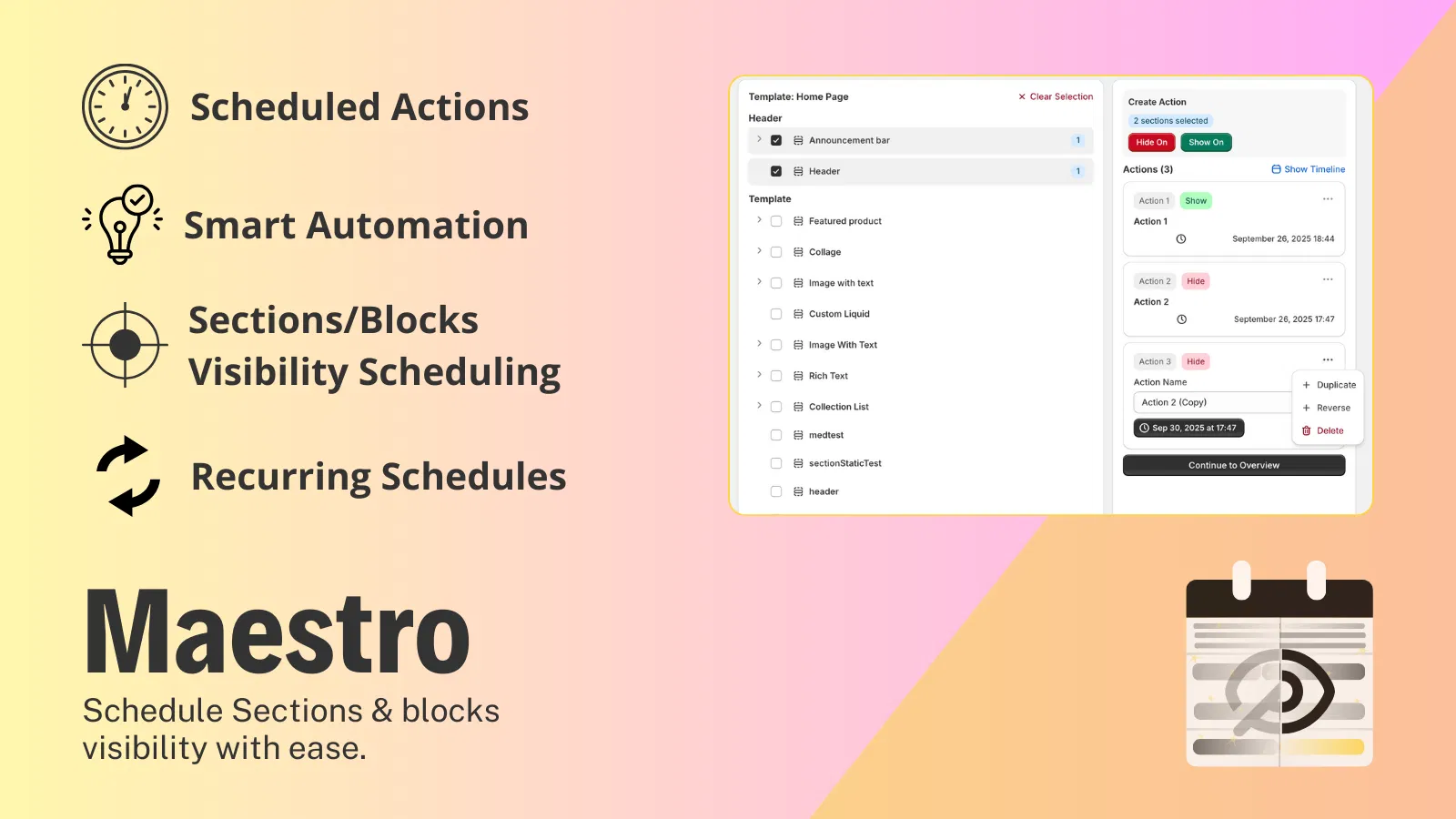
One of the core features of the Maestro Theme Scheduler is the ability to schedule theme publishing. This is vital for merchants who use different theme versions for specific events.
For example, if you have invested in custom Shopify themes for your summer collection and your winter collection, you can schedule the transition between them weeks in advance. Maestro ensures that the correct theme goes live exactly when it should, and it can even revert to your standard theme once the promotional period is over.
Granular Control with Section and Block Visibility
Automation is not just about the entire theme; often, you only need to change a specific part of a page. Maestro allows for automated section and block visibility. This means you can schedule a "Free Shipping" banner to appear only during the weekend or ensure that a "Coming Soon" section on a product page disappears the moment a collection drops.
This level of control is essential for maintaining a clean and relevant user experience. You no longer need to worry about customers seeing expired offers or placeholder content.
Real-World Use Cases: From Black Friday to Daily Drops
To understand the impact of Maestro, let us look at how high-volume merchants utilize storefront automation in their daily operations.
Managing Black Friday and Cyber Monday (BFCM)
During the busiest shopping period of the year, the stakes are incredibly high. A merchant might need to:
- Publish a "Warm-up" theme with early-access deals on Monday.
- Switch to the main Black Friday theme at midnight on Friday.
- Update the homepage sections on Saturday to highlight remaining stock.
- Transition to the Cyber Monday theme on Monday morning.
With Maestro, this entire sequence can be programmed in a single session. This allows the team to focus on customer support and inventory management during the actual sale rather than worrying about the website's appearance.
Flash Sales and Limited Edition Drops
For brands that rely on scarcity and hype, timing is critical. If a drop is scheduled for 10:00 AM, the site must reflect that change instantly. Maestro provides the reliability needed to trigger these updates automatically, ensuring that the "Add to Cart" buttons and promotional banners appear precisely as advertised.
Recurring Weekly Promotions
Many merchants run "Free Shipping Friday" or "Weekend Specials." Setting these up manually every week is a waste of resources. Maestro allows you to create recurring schedules, so your weekend promotional sections go live and expire every week without any further input from your team.
Optimizing Your Workflow: A Step-by-Step Guide to Success
Implementing storefront automation with Maestro is a straightforward process. Here are the simple steps to get your automation strategy up and running.
-
Audit Your Promotional Calendar
- Review your upcoming sales, product launches, and seasonal changes.
- Identify which events require a full theme change versus just a section update.
-
Prepare Your Assets
- Ensure your custom Shopify themes are fully tested and ready in your Shopify admin.
- Design the specific banners or sections you plan to automate.
-
Navigate to the Maestro App
- Open the Maestro interface within your Shopify store.
- Select whether you want to schedule a full theme change or specific section visibility.
-
Define Your Schedule
- Choose the start date and time.
- Select the end date and time if you want the change to revert automatically.
- For recurring events, set the frequency (weekly, monthly).
-
Review and Activate
- Double-check the time zones to ensure alignment with your target audience.
- Click "Save" to put the schedule into action.
Once these steps are completed, your store is effectively on autopilot for those specific events.

Boosting Efficiency and Reducing Maintenance Costs
For many businesses, the cost of ecommerce maintenance services can be significant. Much of this cost is often tied to the manual labor required to keep a site updated. By shifting toward storefront automation, you can redirect your budget from "keeping the lights on" to "growing the business."
High-end Shopify Plus development often involves creating bespoke solutions for complex problems. However, for many day-to-day operational needs, an app like Maestro provides a more cost-effective and reliable alternative to custom-coded scheduling scripts.
Furthermore, automation improves site performance. By scheduling sections to hide when not needed, you can keep your liquid files cleaner and ensure that customers are only loading the content that is relevant to them at that moment. This contributes to better load times and a more streamlined shopping experience.
Enhancing User Experience Through Automation
A well-timed storefront does more than just look good: it builds trust with your customers. When a customer receives an email about a sale and clicks through to find a store that perfectly matches the promotion, it creates a seamless journey. On the other hand, if the store is not updated or shows a different price, that trust is immediately broken.
Automation ensures that your marketing channels and your storefront are always in sync. This synchronization is a vital step in optimizing your conversion rate. By using Maestro to handle these transitions, you provide a professional and reliable experience that encourages repeat purchases.
Conclusion: The Proactive Step Toward Scale
The transition from manual updates to automated storefront management is a significant milestone for any growing ecommerce brand. It represents a shift from being reactive to being proactive. Instead of rushing to fix things or update banners in real time, you are planning for success and building a system that can handle the demands of a modern retail environment.
Maestro offers the tools necessary to master this transition. By automating theme publishing and section visibility, you protect your brand, empower your team, and provide a better experience for your customers. Whether you are managing complex Shopify design services or simple weekly updates, the "set it and forget it" nature of Maestro is the key to scaling efficiently.
If you are ready to stop managing your store by the clock and start managing it by strategy, it is time to explore the power of Maestro. For those who need additional help with their automation setup or general store growth, you can always book a meeting with our experts to discuss your specific needs. Embracing storefront automation is not just a technical upgrade: it is a fundamental shift that allows your business to thrive in the competitive world of ecommerce.