
As a Shopify expert, I often see merchants chained to their laptops at midnight on a Friday. They are waiting for the clock to strike twelve so they can manually publish a new theme or toggle a promotional banner. It is a ritual that feels productive but is actually a drain on your most valuable resource: time. You are seeking a way to scale your operations without losing your sanity. You want your shopify store setup to be dynamic, responsive, and, most importantly, automated.
The reality of modern e-commerce is that timing is everything. A sale that starts ten minutes late or a custom Shopify theme that fails to load correctly during a peak traffic window can cost thousands in lost revenue. This is where the Maestro Theme Scheduler enters the conversation. It is not just an app. It is a workflow optimization tool designed to handle the heavy lifting of content visibility while you focus on high-level growth strategies.
Why You Should Automate Your Store Launches
Before we dive into the technicalities, we must understand the why. Automation is the backbone of successful conversion rate optimization. If your store looks the same in July as it did in December, you are leaving money on the table. Customers expect freshness. They expect relevance.
- Consistency is Key: Automation ensures your marketing messages match your storefront across all time zones.
- Reduced Human Error: Manual updates are prone to mistakes. Scheduling removes the "fat finger" risk during high-pressure launches.
- Operational Freedom: Your team can build and schedule campaigns during office hours, not during their sleep cycles.
- Enhanced Customer Experience: A site that updates seamlessly feels more professional and trustworthy to the end user.
Understanding the Maestro Interface
Maestro Theme Scheduler was built with a minimalist philosophy. The goal is to get you from point A to point B with the fewest clicks possible. When you first open the app, you will notice a clean UI designed to mirror the native Shopify experience. This reduces the learning curve significantly.
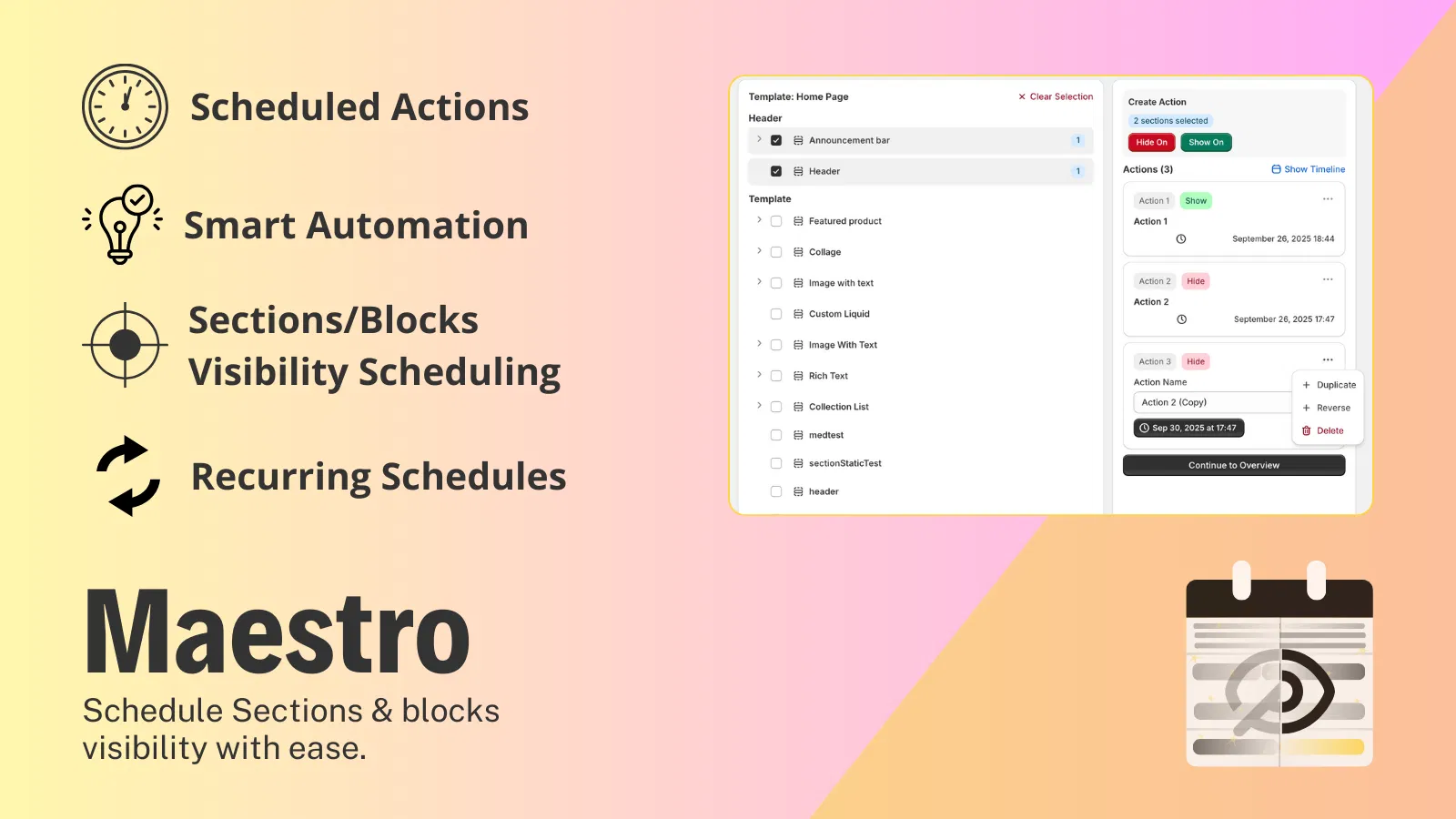
The dashboard provides a bird's eye view of your scheduled actions. You can see what is currently live, what is queued for the future, and what has recently expired. This level of transparency is vital for managing complex custom Shopify themes that require multiple moving parts to work in harmony.
Core Features for the Beginner User
To master Maestro, you need to understand its three primary pillars. These features are the foundation of any automated store strategy.
1. Theme Publishing
This is the macro level of scheduling. You can prepare an entire theme for a major event, such as a Black Friday sale or a brand refresh, and set it to go live at a precise second. Once the event is over, you can schedule your previous theme to revert automatically.
2. Section and Block Visibility
This is where the magic happens at the micro level. Sometimes you do not need a whole new theme. You just need to show a specific "Free Shipping" banner for forty-eight hours. Maestro allows you to target specific sections or blocks within your current theme and control exactly when they appear and disappear. This is a game changer for conversion rate optimization.
3. Recurring Schedules
E-commerce often follows a rhythm. Perhaps you have a "Flash Sale Friday" every week. Instead of setting this up manually every Thursday night, you can create a recurring schedule. Set it once, and Maestro will handle the toggle every single week until you tell it to stop.
Step-by-Step: Your First Scheduled Launch
Setting up your first automation does not have to be intimidating. Follow these simple steps to go from a manual process to a hands-off operation.
Step 1: Navigate to the App Interface
Open your Shopify admin and select Maestro Theme Scheduler from your apps list. The interface is designed to be intuitive, but if you ever feel lost, the Maestro Theme Scheduler page has additional resources.
Step 2: Choose Your Target
Decide whether you want to schedule an entire theme or just a specific section. For beginners, starting with a section visibility toggle is a great way to get comfortable. Select the theme you are currently working on from the dropdown menu.

Step 3: Identify the Section or Block
Using the integrated selector, pick the element you want to automate. You will see a list of sections that matches your Shopify theme editor. This tight integration ensures that what you see in the app is exactly what will happen on the storefront.
Step 4: Set the Timeline
Enter the start date and time. Then, enter the end date and time. Be mindful of your store's time zone settings. If you are running a global brand, ensure your launch times align with your primary market's peak shopping hours.
Step 5: Review and Activate
Give your schedule a descriptive name. Instead of "Schedule 1," try "Summer Sale Banner - July Launch." This makes it much easier to manage your dashboard as your list of automations grows. Click "Save" and you are done.
Integrating with Your Marketing Strategy
Automation should not exist in a vacuum. It should be a core component of your digital marketing efforts. When you plan a campaign, you are likely coordinating email blasts, social media posts, and paid ads. Maestro ensures that your "landing pad," which is your Shopify store, is ready for that traffic.

As a Shopify expert, I often recommend mapping out your content calendar at least thirty days in advance. With Maestro, you can spend one afternoon setting up all your storefront changes for the entire month. This proactive step allows your creative team to move on to the next project without worrying about the execution of the current one.
Managing Your Store on the Go
The world does not stop when you leave your desk. Sometimes you need to make a quick adjustment while you are away from your workstation. Maestro recognizes this need by offering a mobile-friendly experience.

Whether you are using Shopify or even managing certain aspects of your brand via Webflow, having the ability to check your schedules from a smartphone is essential. You can pause a schedule, edit a time, or verify a launch while you are in a meeting or on the move. This flexibility is a cornerstone of modern store management.
Advanced Tips for Sophisticated Launches
Once you have mastered the basics, you can start exploring more complex setups.
- Grouped Schedules: If you have multiple sections that need to go live at the same time, group them together under one master schedule. This ensures a cohesive look across your entire page.
- Notes and Documentation: Use the "Notes" feature within Maestro to explain the purpose of a schedule to other team members. This is vital for agencies or larger teams working within the same Shopify admin.
- Testing with Preview Links: Always use Shopify's native preview functionality to see how your theme looks before it goes live. Maestro works alongside these previews to give you peace of mind.

The Impact on Your Bottom Line
At the end of the day, using a tool like Maestro is about performance. It is about ensuring that your shopify store setup is working for you, not against you. By automating the mundane tasks of content management, you free up mental energy for high-impact decisions.
If you are struggling with a complex migration or need help optimizing your store for speed, checking out migration to Shopify or Shopify speed optimization can provide the technical foundation you need. But even the fastest store in the world needs a content strategy that is executed with precision.
Taking the Next Step in Your Automation Journey
Mastering automated launches is a vital step toward professionalizing your e-commerce business. It moves you from a reactive state where you are always putting out fires to a proactive state where you are in total control of your brand's narrative.
As you become more comfortable with Maestro, you will find that your ability to test new ideas increases. Want to try a four-hour flash sale on a Tuesday morning? You can set it up in five minutes and forget about it. This agility is what separates the top 1% of Shopify merchants from the rest.
If you want to take your store to the next level, I encourage you to explore our growth strategies or book a meeting with our team. We specialize in turning complex e-commerce challenges into streamlined, automated success stories.
The road to a stress-free launch starts with a single schedule. Start small, automate one banner, and watch how much more time you have to actually grow your business. Automation is not just a luxury for the big players anymore. It is a necessity for anyone serious about e-commerce. Stop clicking and start scheduling. Your future self will thank you.