
As a Shopify expert, I often see merchants living in a state of perpetual "Midnight Launch Anxiety." You know the feeling. It is 11:55 PM on a Thursday, and instead of sleeping, you are hovering over the "Publish" button for your new collection, frantically double checking that the tags are correct and the prices are not accidentally set to zero. This manual approach to ecommerce maintenance services is not just exhausting: it is a recipe for human error that can tank your conversion rate optimization efforts in a heartbeat.
In the world of high-growth retail, your time is better spent on strategy than on clicking buttons in the Shopify admin at odd hours. Whether you are handling a massive seasonal drop or just trying to keep your shopify store setup organized, automation is the only way to scale without losing your mind.
By using tools like the Maestro Product Scheduler, you can transform your store into a self-running machine. Here is the definitive five-step guide to scheduling your product launches and tags for a truly hands-off ecommerce experience.
Step 1: Master the Pre-Launch with the Draft Helper
The first hurdle in any product launch is the preparation phase. Most merchants struggle with the "Draft" status. You want everything ready, but you are terrified that a misclick will send a half-finished product live to your customers.
The Draft Helper feature within Maestro is designed to eliminate this fear. It allows you to prepare your products in a sandbox environment and schedule their transition from draft to active at a precise second.
- Avoid the accidental leak: By keeping products in draft mode and scheduling the status change, you ensure that no "test" products ever show up on your storefront prematurely.
- Sync with marketing: Align your product activation with your email marketing and social media countdowns. If your newsletter hits inboxes at 10:00 AM, your products should go live at 10:00 AM, not 10:05 AM when you finally find the "Save" button.
- Bulk management: Use this step to handle hundreds of products at once. Instead of editing each product individually, schedule a bulk action to flip the switch on an entire collection.
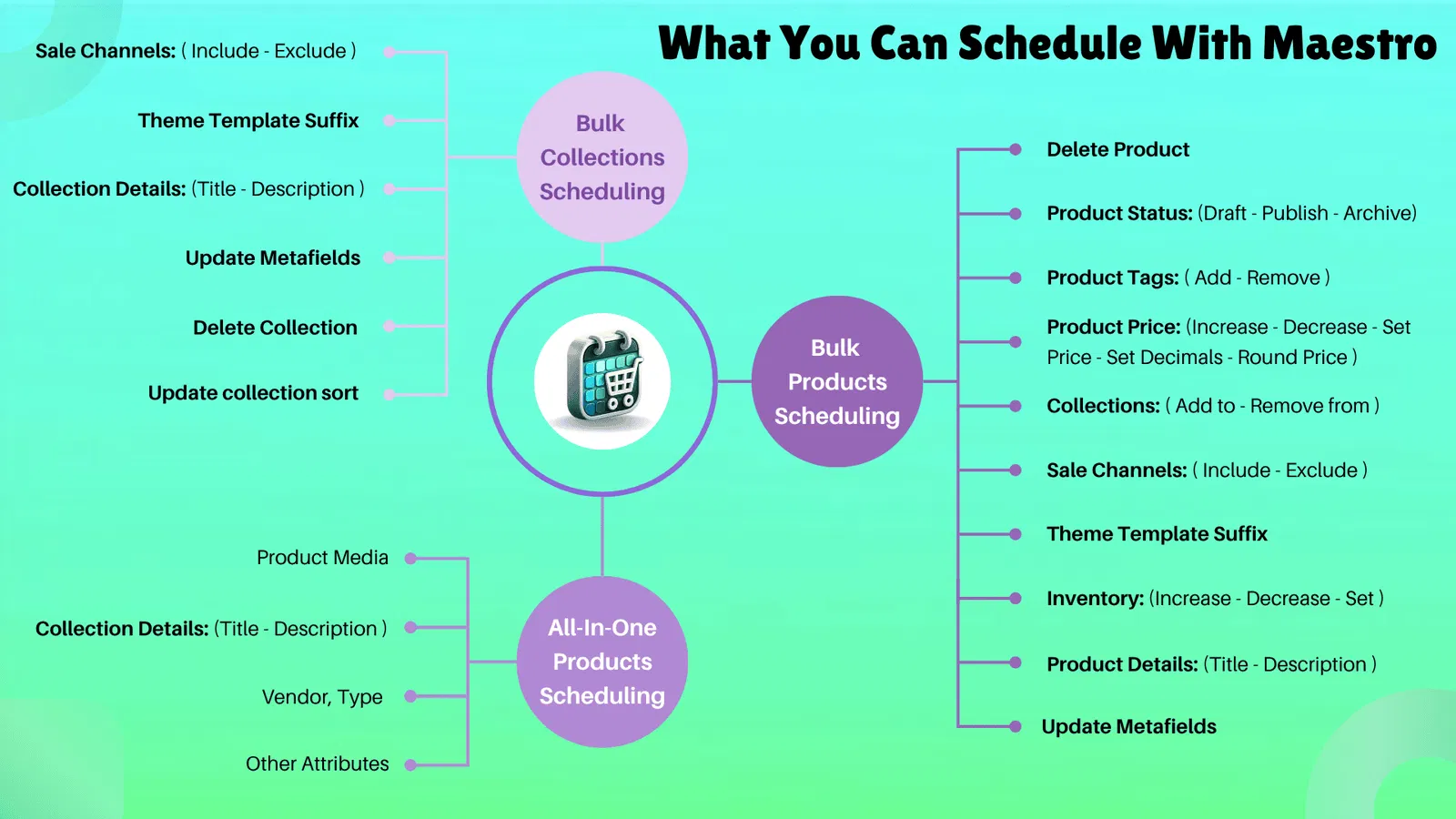
Step 2: Automate Tag Management for Seamless Organization
Tags are the invisible glue that holds your Shopify store together. They power your filters, your smart collections, and even some of your SEO elements. However, manual tagging is a nightmare. Forget one tag, and your product disappears from the "New Arrivals" collection. Forget to remove an "On Sale" tag, and you are accidentally giving discounts long after the promotion ends.
Automating your tag management is a vital part of conversion rate optimization. When a customer uses a filter and finds exactly what they need because your tags are accurate, the likelihood of a sale skyrockets.
- Schedule tag additions: Automatically add tags like "New" or "Summer-Drop" the moment a product goes live.
- Auto-remove seasonal tags: Set a date for "Black Friday" tags to disappear. This prevents "Ghost Sales" where customers see sale badges on products that are back to full price.
- Power your smart collections: By scheduling tags, you are effectively scheduling which products appear in which collections. This is a far more efficient way to manage your featured collections on the home page.
Step 3: Implement Strategic Price Changes and Rounding Rules
Pricing strategy is rarely "set it and forget it." Between flash sales, holiday discounts, and wholesale adjustments, your prices are constantly in flux. Doing this manually is not only slow but risky. A typo in a price field can cost you thousands of dollars in minutes.
Beyond just changing numbers, you need to consider the psychology of pricing. This is where rounding rules come into play. A price of $19.99 often performs better than $20.00, but calculating those decimals across a 500-item catalog is a task no human should have to perform.
- Timed price drops: Schedule your sale prices to go live exactly when your promotion starts.
- Automated price reverts: Ensure prices return to their original state the moment the sale ends, protecting your margins.
- Consistent rounding rules: Use Maestro to apply rounding logic across all scheduled price changes. Ensure every product ends in .99 or .95 automatically to maintain a professional brand image.
- Protect your UX: If you are worried about how your prices look to the customer, consider an optimization audit report to see how pricing displays affect your user journey.

Step 4: Automate Inventory and Restock Workflows
Inventory management is the backbone of ecommerce maintenance services. There is nothing more frustrating for a customer than finding the perfect item only to see it is out of stock. Conversely, when you restock an item, you want it to jump back into the spotlight immediately.
Inventory automation allows you to handle restocks without manually updating every product page. If a shipment arrives on Wednesday but you want the "Back in Stock" announcement to happen on Friday, you can schedule the inventory update to reflect that.
- Trigger visibility based on stock: Set rules to hide products when inventory hits zero and show them again when stock is replenished.
- Manage restock hype: Schedule inventory increases to go live alongside a "Restock Alert" marketing campaign.
- Prevent overselling: By automating the sync between your physical stock and your Shopify admin, you reduce the risk of selling items you do not have on hand.
Step 5: Optimize Collection Visibility and Sorting
The final step in a stress-free launch is controlling how the customer sees your products. Simply making a product "Active" is not enough. You need it to be at the top of the relevant collections to maximize visibility.
If you are launching a new line, those products should automatically move to the first page of your "Shop All" collection. If you are running a clearance, those items should move to the bottom. Managing this manually every day is a full-time job.
- Schedule collection visibility: Use Maestro to show or hide entire sections of your store based on the time of day or specific dates. This is perfect for limited-time "Drop" brands.
- Dynamic sorting: Schedule changes to your collection sort orders. Move high-margin items to the top during peak traffic hours.
- Mobile-friendly management: You should be able to oversee these changes from anywhere. Whether you are at your desk or on the go, ensure your scheduling tool offers a clean mobile interface.

Why Automation is the Secret to Scaling
Many merchants view automation as a luxury, but as your SKU count grows, it becomes a necessity. When you move away from manual shopify store setup and embrace scheduled actions, you gain more than just free time. You gain accuracy.
Human error is the silent killer of conversion rates. A broken tag that excludes a best-seller from a collection or a price that didn't update on time can lead to customer frustration and lost trust. By using the Maestro Product Scheduler, you are building a safety net into your operations.
- Reduce operational overhead: You no longer need a staff member dedicated to "pushing things live" at odd hours.
- Improve work-life balance: Launch your biggest sale of the year while you are out at dinner, knowing the app is handling the heavy lifting.
- Data-driven timing: Instead of launching when it is convenient for you, launch when the data says your customers are most active.

Building a Hands-Off Future
The goal of every ecommerce business should be to move toward a hands-off model where the "boring" parts of the business run themselves. Scheduling product launches and tags is the first and most impactful step in that journey.
When your store is perfectly timed, your marketing is in sync, and your inventory is automated, you can finally focus on what matters: growing your brand and talking to your customers.
If you are ready to stop the midnight manual updates and start scaling with precision, it is time to look at how automation can transform your workflow. From managing tags to ensuring your domain is set up for maximum impact, every small automation adds up to a massive competitive advantage.
Take a proactive step today. Explore the possibilities of the Maestro app and give yourself the gift of a stress-free launch. Your sleep schedule (and your bank account) will thank you.