
As a Shopify expert, I often witness a specific kind of exhaustion that haunts the faces of ecommerce founders. It is the look of someone who has spent the last six hours manually updating product tags, double-checking inventory counts, and refreshing their browser at midnight to ensure a sale price actually went live. They started their business to innovate and sell, yet they spend half their life providing manual ecommerce maintenance services that could easily be handled by a sophisticated robot.
If you are seeking a way to reclaim your weekends and eliminate the constant fear of human error, you are in the right place. The Maestro Product Scheduler is not just another app to clutter your dashboard. It is a strategic pivot in how you handle your shopify store setup. By automating the repetitive, high-stakes tasks of product management, you can focus on high-level growth while your store practically runs itself.
The High Cost of Manual Ecommerce Maintenance
Before we dive into the solution, we need to acknowledge the problem. Running a high-growth Shopify store requires constant updates. Sales come and go, seasons change, and inventory fluctuates. When these updates are done manually, two things happen. First, you lose time that should be spent on conversion rate optimization and marketing. Second, you eventually make a mistake.
A single typo in a price or a forgotten tag can lead to thousands of dollars in lost revenue or a customer service nightmare. This is why automated scheduling is no longer a luxury for Shopify Plus merchants; it is a fundamental necessity.
Step 1: Mastering Launches with the Draft Helper
The "Draft Helper" is perhaps the most underrated feature for anyone serious about their shopify store setup. Traditionally, launching a new collection involves a frantic scramble. You have products sitting in draft mode, and you have to manually switch them to "Active" the moment your marketing emails go out.
With Maestro, you can schedule the transition from draft to active with surgical precision. This means you can:
- Prepare your entire collection weeks in advance.
- Set a specific date and time for products to go live.
- Ensure that all sales channels, from Facebook to Point of Sale, update simultaneously.
- Avoid the "404 Error" panic when a customer clicks a link to a product that is not yet active.
By using the Draft Helper, you turn a high-stress launch day into a hands-off experience. You can literally be asleep or on a flight while your new inventory hits the digital shelves.
Step 2: Automated Tag Management for Seasonal Sales
Tags are the invisible glue that holds your Shopify store together. They control your collections, your filters, and often your automation workflows. However, managing them for seasonal sales is a recipe for disaster. I have seen countless stores still displaying "Winter Clearance" tags in the middle of July because someone forgot to run a bulk edit.
Maestro’s automated tag management allows you to schedule the addition and removal of tags based on your promotional calendar.
- Select a group of products for a flash sale.
- Schedule the "Flash Sale" tag to appear at 8 AM on Friday.
- Set the tag to disappear automatically at midnight on Sunday.
- Let your smart collections do the heavy lifting of sorting products based on these scheduled tags.
This level of automation ensures your store always looks current and professional, which is a key component of conversion rate optimization.

Step 3: Scheduling Price Changes and Rounding Rules
Pricing strategy is a living thing. You might want to run a weekend promotion, or perhaps you need to adjust prices across an entire category due to rising supplier costs. Doing this manually for hundreds of SKUs is not just tedious; it is dangerous.
Maestro allows you to schedule price changes with incredible granularity. You can choose to:
- Increase or decrease prices by a percentage: Perfect for store-wide sales or inflation adjustments.
- Set specific values: Ideal for fixed-price promotions.
- Apply rounding rules: This is where the magic happens. You can ensure that after a 15 percent discount is applied, your prices still end in .99 or .95.
Consistent pricing aesthetics are vital for brand trust. A store that has prices like $14.37 and $19.82 looks messy and unoptimized. Automated rounding rules ensure your pricing remains clean and psychologically appealing to shoppers.

Step 4: Inventory Automation for Restocks
Nothing kills a conversion rate faster than an "Out of Stock" button. While you can’t always control your supply chain, you can control how your store reacts to it. Maestro’s inventory automation allows you to schedule restock updates and manage visibility based on stock levels.
If you know a shipment is arriving on Tuesday, you can schedule those products to become available for purchase at a specific time. You can also automate the process of hiding products that fall below a certain inventory threshold, ensuring your customers never have a bad experience by trying to buy something you don't have.
This proactive approach to inventory management is a core part of our ecommerce maintenance services at XCO Agency. It keeps the storefront clean and the customer journey friction-free.
Step 5: Managing Collection Visibility and Sorting
Your homepage and collection pages are your digital storefront windows. You wouldn't leave a Christmas display up in February in a physical store, and you shouldn't do it online either.
Maestro allows you to schedule when specific collections are visible on your site. You can also automate the sorting logic. For example, during a holiday sale, you might want your "Best Sellers" to stay at the top of the collection, but once the sale ends, you may want to revert to "Newest Arrivals."
Here are the simple steps to automate your collections:
- Navigate to the Maestro dashboard and select the Collection Scheduler.
- Choose the collection you want to modify.
- Set the "Sort Order" to change at a specific date and time.
- Ensure the collection is added or removed from the navigation menu automatically.
This ensures that your most relevant and high-converting products are always front and center without you having to lift a finger.

Reducing Human Error and Gaining Peace of Mind
The real benefit of Maestro’s Product Scheduler isn't just the time saved; it is the reduction of cognitive load. As a CEO or store manager, your brain is constantly running a checklist of "Did I remember to do X?" When you automate your ecommerce maintenance, that checklist disappears.
By moving to a "set it and forget it" model, you eliminate the risk of:
- Forgetting to end a sale, leading to lost margins.
- Launching a product with the wrong price.
- Leaving "Ghost" products on your site that are actually out of stock.
- Messy collection pages that confuse your customers.
When your shopify store setup is optimized through automation, your store becomes a lean, mean, selling machine that operates with the precision of a Swiss watch.
Why XCO Agency Recommends Maestro
At XCO Agency, we specialize in helping Shopify Plus merchants scale. We have seen firsthand that the difference between a store that plateaus and one that thrives is often the quality of their internal systems. Maestro is a pillar of a high-performance system.
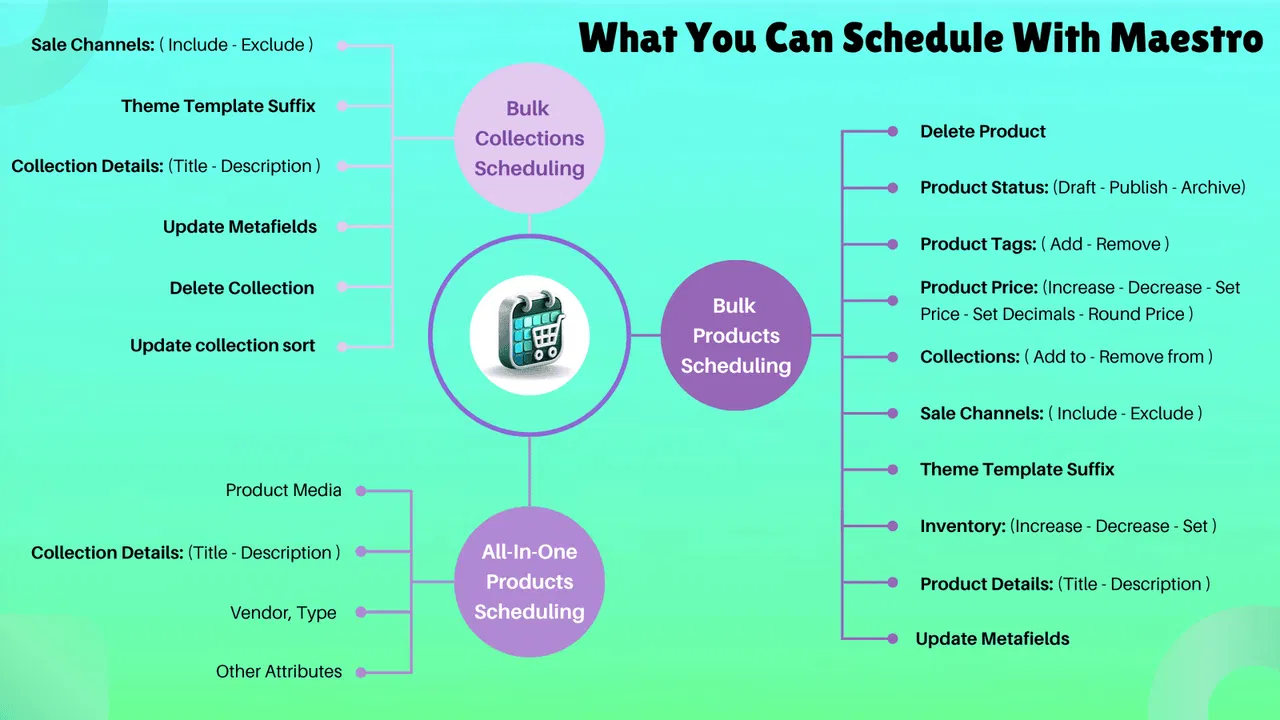
If you are looking to boost your store’s efficiency and significantly improve your workflow, integrating this level of scheduling is a vital step. Whether you are preparing for a massive Black Friday event or just trying to manage weekly restocks, the ability to schedule every attribute of your products gives you a level of control that manual management simply cannot match.
Final Thoughts: Taking the Proactive Step
In the world of ecommerce, the only constant is change. You can either spend your life reacting to those changes, or you can use tools like the Maestro Product Scheduler to get ahead of them.
Automating your product management is more than just a convenience; it is a fundamental part of conversion rate optimization. A store that is always accurate, always updated, and always relevant will naturally outperform one that is bogged down by manual errors and outdated content.
If you are ready to stop being a slave to your Shopify admin and start acting like the CEO of a global brand, it is time to automate. Check out our apps and services to see how we can help you streamline your operations.
Ready to take your store to the next level? Book a meeting with our experts today and let's talk about how we can automate your path to growth. Your future self, and your sleep schedule, will thank you.