
As a Shopify expert, I often find myself looking at the backend of massive stores only to find a digital version of a "lost and found" bin. You know the one. It is a messy, unorganized collection of emails, frantic customer support tickets, and spreadsheets that look like they were designed in 1998. When you are dealing with enterprise ecommerce solutions, the stakes are significantly higher. A single lost return or a delayed refund does not just cost you one sale; it costs you a lifetime of customer loyalty.
Managing returns, refunds, and warranty claims at scale is the silent killer of productivity. Most merchants are seeking a way to automate the "boring stuff" so their team can focus on growth. That is where Claimify enters the chat. This app is not just a tool; it is a fundamental shift in how we handle the post-purchase experience. By moving from manual inbox management to a unified dashboard, Claimify turns a cost center into a streamlined machine.
In this guide, I will break down why Claimify is becoming the gold standard for merchants who want to optimize their ecommerce maintenance services and build a support system that actually works for them, rather than against them.
The Problem with Traditional Support Inboxes
Before we dive into the solution, we have to acknowledge the pain. As a store grows, the support volume does not just increase linearly; it explodes. Suddenly, you have three different people trying to answer the same "Where is my refund?" email, while another customer is complaining on Instagram that their exchange has been pending for three weeks.
When you rely on a standard email inbox, you suffer from:
- Information Fragmentation: Customer data lives in Shopify, shipping info lives in a carrier portal, and the claim request is buried in a thread of 15 emails.
- Manual Validation Fatigue: Your team has to manually check if a product is still within the warranty period or if the customer is eligible for a return.
- Customer Anxiety: Without a transparent process, customers feel like their request has vanished into a black hole, leading to more "follow-up" tickets that further clog the system.
Enterprise ecommerce solutions require a level of precision that manual labor simply cannot provide. You need a system that validates, organizes, and executes claims without constant human intervention.
Why Claimify is a Game Changer
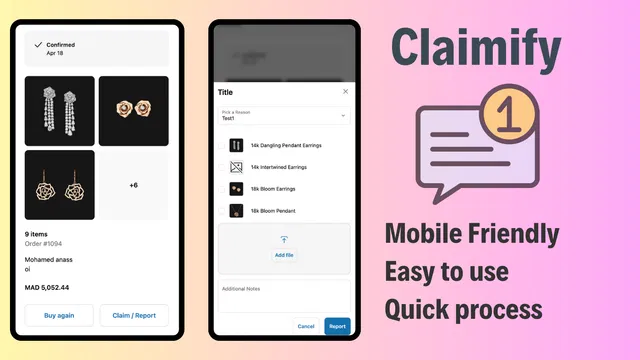
Claimify shifts the power back to the merchant and the customer. It creates a dedicated portal where claims are handled with the same level of polish as the initial shopping experience. Here is why this app is essential for any high-volume store:
- Unified Command Center: All returns, refunds, exchanges, and warranty claims are gathered in one dashboard. No more jumping between tabs.
- Smart Automation Rules: You can set specific logic to auto-approve or auto-reject claims based on order age, product type, or claim reason.
- Self-Service Functionality: Customers can file their own claims directly from your storefront or the thank-you page, reducing the initial contact load by up to 80 percent.
- Professional Branding: The claim portal looks and feels like part of your store, maintaining trust throughout the most sensitive part of the customer journey.
Step-by-Step: Implementing Claimify for Enterprise Growth
If you are ready to stop the bleeding in your support department, follow these steps to get Claimify up and running. Once your installation is complete, the difference in your daily operations will be night and day.
Step 1: Connect Your Store and Customize the Portal
Navigate to the Shopify App Store and install Claimify. The first thing you should do is align the portal with your brand identity. Enterprise ecommerce solutions should never look like a third-party bolt-on. Customize the colors, fonts, and messaging to ensure a seamless transition for the customer.
Step 2: Define Your Claim Types
Not all claims are created equal. You need to decide what you are offering:
- Returns: Standard "I changed my mind" scenarios.
- Exchanges: Swapping for a different size or color.
- Damaged Goods: Claims specifically for items that arrived broken.
- Warranty: Longer-term claims for product performance issues.
By categorizing these early, you allow Claimify to bucket the requests correctly, making it easier for your team to process them in batches.
Step 3: Set Up Automated Validation Rules
This is where the magic happens. You can create rules that say: "If the order was delivered more than 30 days ago, do not allow a refund." Or: "If the item is a final sale product, hide the return option."

Using imperative logic like "Allow," "Restrict," and "Validate" ensures that your ecommerce maintenance services are consistent. You eliminate the risk of a support agent accidentally approving a claim that violates your policy.
Step 4: Integrate the Claim Link Everywhere
Do not make your customers hunt for the claim form. Place the link in your footer, in your navigation menu, and most importantly, on the order thank-you page. When a customer knows exactly where to go if something goes wrong, their confidence in making the purchase increases significantly.
Improving the Customer Post-Purchase Experience
We often talk about "conversion rate optimization" in terms of getting people to buy. However, true enterprise ecommerce solutions focus on the entire lifecycle. A smooth return process is actually a powerful marketing tool. If a customer knows they can swap a shirt that does not fit without a two-week email battle, they are far more likely to buy three shirts next time.
Claimify allows customers to upload photos of damaged items directly through the form. This is vital for "damaged on arrival" claims. Instead of your agent asking for photos, the customer provides them upfront. This reduces the "back-and-forth" and allows for one-click resolutions.

Data-Driven Decisions: Beyond the Support Ticket
One of the most overlooked benefits of using a tool like Claimify is the business intelligence it provides. When all your claims are in one place, patterns begin to emerge.
As a Shopify expert, I often use this data to advise clients on product quality. For example, if you notice that 40 percent of your "damaged" claims are coming from a specific SKU, you have a manufacturing or packaging problem, not a support problem. Claimify highlights these trends, allowing you to take proactive steps to fix the root cause. This is a core part of effective ecommerce maintenance services. It is about maintaining the health of the entire business, not just fixing individual bugs.
Scaling with Enterprise Ecommerce Solutions
For enterprise-level brands, manual tasks are the enemy of scale. You cannot hire your way out of a bad process. If you have 50,000 orders a month, even a 2 percent return rate equals 1,000 claims. Handling 1,000 claims via email is a full-time job for several people. Handling them via Claimify might take one person a few hours a week to oversee the automated approvals.
By implementing these enterprise ecommerce solutions, you are essentially buying back time for your team to work on high-impact projects, like loyalty programs or product development.

The Shift to Proactive Support
The goal of Claimify is to move your support team from being reactive (putting out fires) to being proactive (managing a system). When the system handles the mundane validations, your agents can spend their time on "high-touch" cases where a customer is genuinely upset and needs a human touch.
After completing the setup of your automation rules, you will notice that the "status check" emails disappear. Customers can see the progress of their claim in real-time. This transparency is the cornerstone of modern ecommerce.
Conclusion: Claiming Your Sanity Back
Transitioning your support from a messy inbox to a unified dashboard like Claimify is a vital step for any growing brand. It reduces manual work by up to 80 percent, improves the customer experience, and provides the data you need to optimize your product catalog.
Enterprise ecommerce solutions are only as good as the systems that support them. If your post-purchase process is a bottleneck, your growth will eventually stall. By leveraging automation and a centralized dashboard, you ensure that your brand remains professional and efficient, even as you scale to thousands of orders.
If you are looking to audit your current support flow or need help integrating advanced ecommerce maintenance services into your Shopify store, we are here to help. At XCO Agency, we specialize in making complex systems simple.
Take the first step toward a cleaner inbox and a happier customer base. Stop wrestling with spreadsheets and start using a system designed for the modern era of commerce. Your team, and your customers, will thank you for it.
Ready to transform your support experience? Contact XCO Agency today and let's discuss how we can optimize your enterprise ecommerce solutions for long-term success.