
As a Shopify expert, I often talk to merchants who are essentially prisoners of their own success. They have built a brand, they have the traffic, and they have the products. However, they are also waking up at 3:00 AM to manually publish a New Arrivals collection or spending half their Sunday updating price tags for a flash sale. This is not the dream of entrepreneurship that most people signed up for.
Most store owners are seeking a way to automate the repetitive, soul-crushing parts of catalog management. They want a store that runs itself, updates itself, and sells itself while they focus on high-level growth strategies. The good news is that achieving a hands-off Shopify catalog is not a multi-month development project. With the right tools, specifically the Product Scheduler by Maestro, you can set up a fully automated workflow in about five minutes.
In this guide, I will walk you through how to leverage automation to handle everything from product launches to inventory restocks without lifting a finger.
Why You Need a Hands-Off Catalog Strategy
Before we dive into the how, let's talk about the why. Managing a Shopify store setup manually is a recipe for human error. A forgotten tag can break a collection filter. A delayed price update can tank your margins or frustrate customers.
By implementing automation, you gain several key advantages:
- Consistency in Branding: Products go live exactly when you promised, maintaining trust with your audience.
- Reduced Operational Overhead: You stop paying for manual ecommerce maintenance services that could be handled by software.
- Improved Conversion Rate Optimization: When your collections are always fresh, your tags are accurate, and your inventory is updated in real-time, the customer experience is seamless.
- Mental Freedom: You can actually take a vacation without worrying about whether the Tuesday morning drop happened correctly.
Feature 1: The Draft Helper for Scheduled Launches
The most common pain point in Shopify is the lack of a robust "set and forget" system for new products. While Shopify has basic scheduling, it often falls short when you need to coordinate multiple attributes across dozens of items.
The Draft Helper within the Maestro app is designed to be your digital assistant. Instead of manually toggling status from draft to active, you can schedule the exact second a product goes live. This is vital for high-hype drops where timing is everything.
As a Shopify expert, I often recommend using the Draft Helper to batch your work. You can spend one hour on a Monday setting up all your launches for the next month. Once the clock hits the scheduled time, the app handles the heavy lifting, ensuring the product status shifts and it appears exactly where it should.
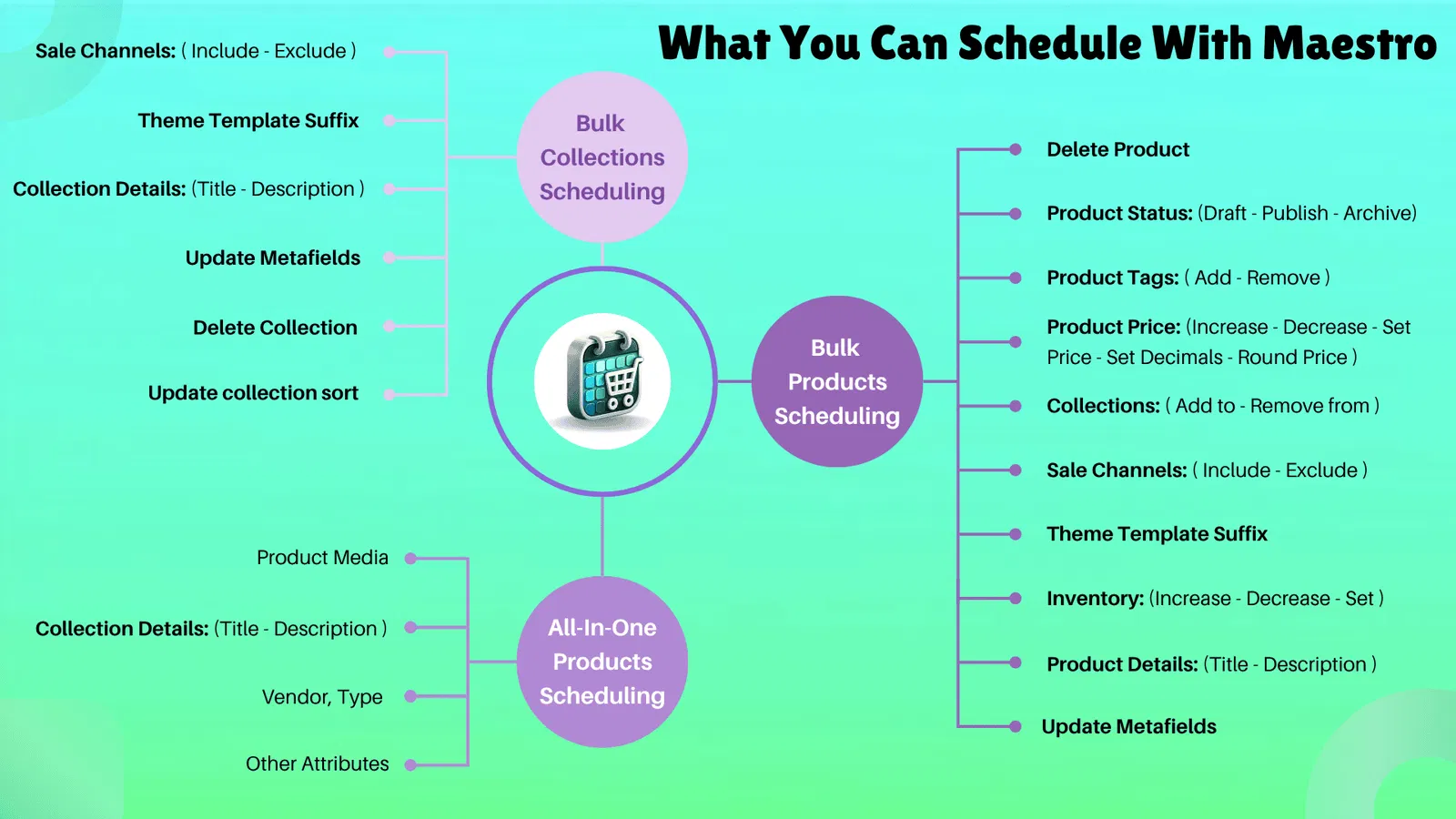
Feature 2: Automated Tag Management for Seasonal Sales
Tags are the invisible glue that holds a Shopify store together. They power your filters, your smart collections, and often your marketing automations. However, managing them is a nightmare during seasonal shifts.
Imagine you are running a Summer Clearance sale. You need to add a "Sale" tag to 500 items on Friday and remove it on Monday. Doing this manually is a waste of talent. With Maestro, you can schedule tag additions and removals.
This automated tag management ensures that:
- Products enter the "On Sale" collection at the right time.
- Search filters update instantly to reflect current availability.
- Marketing pixels triggered by tags fire correctly without manual intervention.
This level of precision is a key part of conversion rate optimization. If a customer clicks an ad for a sale and the products aren't tagged correctly in the store, they leave. Automation prevents that bounce.
Feature 3: Scheduling Price Changes and Rounding Rules
Pricing is dynamic. Whether you are adjusting for a holiday weekend or responding to supply chain shifts, your prices need to change. But manual price updates are dangerous. One misplaced decimal point can cost you thousands.
The Product Scheduler by Maestro allows you to schedule price changes in bulk. More importantly, it includes sophisticated rounding rules. If you want all your sale prices to end in .99 or .95 to maintain a specific psychological pricing strategy, the app handles it automatically.
Here is how a typical workflow looks:
- Select the products for the promotion.
- Set a percentage or flat-rate discount.
- Apply a rounding rule (e.g., round to the nearest .99).
- Set the start and end date for the price change.
Once the sale ends, the app reverts the prices to their original state. This is true hands-off management.

Feature 4: Inventory Automation and Restock Management
There is nothing more frustrating than having a restock arrive at your warehouse, but the product is still marked as "Sold Out" on the storefront because someone forgot to update the status or collection visibility.
Inventory automation within the Maestro app allows you to create triggers based on stock levels. If an item hits zero, you can automatically hide it or move it to the bottom of a collection. Conversely, when stock is added, the app can immediately make the product visible and add a "Back in Stock" tag.
This ensures your catalog always looks healthy and curated. For more advanced setups, you might want to look into Shopify speed optimization to ensure that these dynamic updates don't slow down your site performance.
Feature 5: Managing Collection Visibility and Sorting
Your homepage and main collection pages are your most valuable digital real-time. You want your best sellers and newest items at the top. Manually re-sorting collections every day is impossible as you scale.
Maestro allows you to schedule collection visibility and sorting rules. You can show a "Holiday Gift Guide" collection only during the month of December. You can automate the sorting so that products with the highest inventory appear first, or products with a specific "Trending" tag are boosted to the top.
By keeping your most relevant products in front of customers, you significantly improve the effectiveness of your growth strategies.

How to Set It Up in 5 Minutes: Step-by-Step
If you are ready to stop being a manual data entry clerk and start being a CEO, follow these simple steps to automate your catalog.
Step 1: Install the Maestro App
Navigate to the Shopify App Store and install the Product Scheduler by Maestro. This tool is the backbone of your automation strategy. It is built specifically for merchants who need high-level control without complex coding.
Step 2: Configure Your Draft Helper
Go to the app dashboard and select the Draft Helper settings. Define your default launch times. If you usually drop products at 10:00 AM on Thursdays, set this as a preset. This saves you from having to type it in every single time.
Step 3: Create Your Tagging Templates
Set up templates for common events. Create a "Flash Sale" template that adds the tag "Sale" and removes it after 24 hours. Once these templates are created, applying them to a new batch of products takes seconds.
Step 4: Establish Price Rounding Rules
Navigate to the pricing section and toggle on the rounding rules. Choose your preferred decimal (e.g., .99). This ensures that no matter what discount you apply in the future, your storefront remains professional and consistent.
Step 5: Schedule Your Collections
Select your key seasonal collections and set their visibility dates for the entire year. If you have a Valentine's Day collection, schedule it to appear on January 15th and disappear on February 15th right now.

The Impact on Your Bottom Line
A hands-off catalog is not just about convenience; it is about profitability. When your store is automated, you reduce the "lag time" between a business decision and its execution. If you decide to run a sale, it happens instantly across all products, tags, and collections.
Furthermore, this setup allows your team to focus on things that actually move the needle, like Shopify design services or customer acquisition. You are no longer paying for hours of manual labor; you are investing in a system that scales with you.
As a Shopify expert, I have seen stores double their output simply by removing the bottleneck of manual catalog management. When you aren't afraid of the work involved in a product launch, you launch more often. When you aren't worried about the complexity of a sale, you run more promotions.
Final Thoughts on E-commerce Automation
Transitioning to a completely hands-off Shopify catalog is a vital step for any merchant looking to scale. The Product Scheduler by Maestro provides the tools necessary to automate the "Draft Helper" launches, tag management, pricing, and collection visibility that previously required hours of manual work.
By taking five minutes today to set up these automations, you are protecting your store from human error and freeing yourself to focus on the future of your brand. Whether you are just starting your shopify store setup or you are managing a high-volume Plus store, automation is the key to a sustainable business model.
If you need help building out a more complex automation workflow or want to discuss a custom migration to Shopify, we are here to help. At XCO Agency, we specialize in making e-commerce feel effortless.
Ready to get started? You can book a meeting with our team to see how we can optimize your store for maximum performance and minimum stress. Stop clicking and start growing.