
As a Shopify expert, I often see merchants spending far too many hours on the digital equivalent of moving boxes in a warehouse. They are manually updating tags, hiding out-of-stock items, and refreshing collection pages at midnight to ensure a product launch goes off without a hitch. While this level of dedication is admirable, it is also completely unnecessary. If you are seeking a way to reclaim your time while maintaining a high-performing storefront, you have likely realized that manual ecommerce maintenance services are a bottleneck to your growth.
The truth is that a successful Shopify store setup requires more than just a great theme and a solid product line. It requires a backend strategy that handles the repetitive tasks for you. This is where automation becomes your best friend. By using the Product Scheduler by Maestro app, you can transition from a reactive merchant to a proactive strategist. You can essentially run a hands-off store where product visibility and sorting happen on autopilot.
In this guide, I will break down how you can automate your store operations to boost efficiency and significantly improve your conversion rate optimization.
Why Manual Merchandising Is Killing Your Growth
Before we dive into the how, we need to address the why. Many store owners believe that manual control is the only way to ensure quality. However, human error is a silent profit killer. Here are a few reasons why manual management is holding you back:
- The Midnight Launch Fatigue: Staying up late to publish a new collection or change prices is a recipe for burnout and mistakes.
- The Ghost Product Problem: Forgetting to hide a sold-out product frustrates customers and hurts your brand authority.
- Static Collections: If your "New Arrivals" collection has not changed in three weeks because you have been too busy to reorder it, your returning customers will stop clicking.
- Inconsistent Tagging: Manual tagging often leads to typos or missing tags, which breaks your automated collections and site filters.
By shifting these tasks to an automated system, you ensure that your store remains fresh, accurate, and optimized for sales 24/7.
Automating Product Launches with the Draft Helper
One of the most stressful parts of a Shopify store setup is the big product drop. You have the marketing emails ready to go and the social media posts scheduled, but the products themselves are sitting in draft mode. If you forget to hit publish at the exact right moment, you lose the initial surge of traffic.
The "Draft Helper" feature within the Product Scheduler by Maestro app solves this entirely. Instead of toggling statuses manually, you can set a specific date and time for a product to go live.
Step 1: Prepare Your Product Data
Ensure all your product descriptions, images, and SEO settings are complete while the product is still in draft mode.
Step 2: Schedule the Visibility
Navigate to the Maestro app interface and select the products you wish to launch. Set the "Active" status to trigger at your desired launch time.
Step 3: Set an End Date
If you are running a limited-time drop, you can also schedule when the product should return to draft status or be deleted entirely.
This level of control allows you to prepare weeks in advance, meaning your "work" on launch day is simply watching the orders roll in.
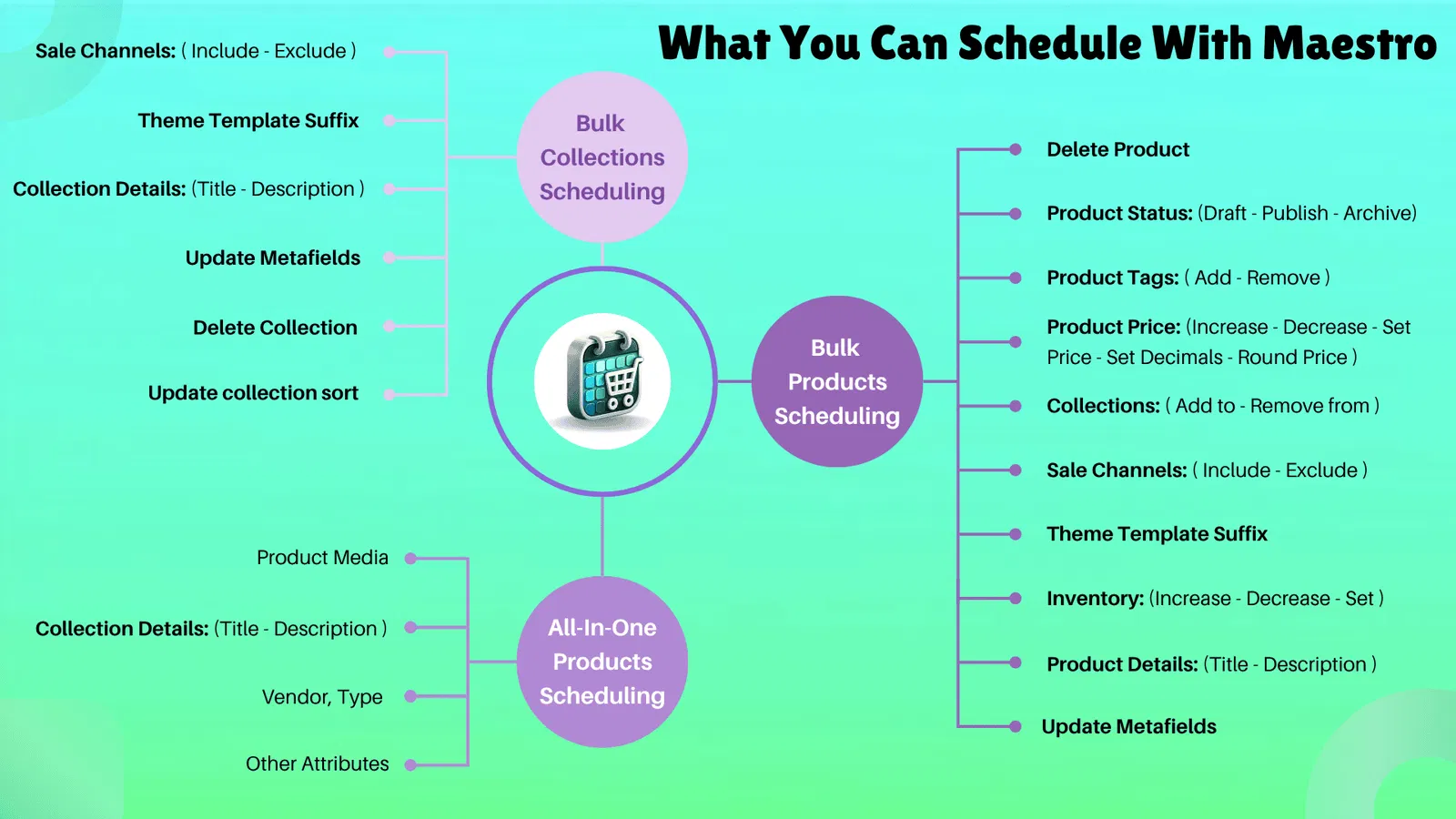
Master Your Seasonal Sales with Automated Tag Management
Tags are the invisible engine of a Shopify store. They power your filters, your smart collections, and even some of your marketing automations. However, managing them for seasonal sales can be a nightmare. Imagine having to add a "Summer Sale" tag to 500 items and then remembering to remove it the moment the sale ends.
With automated tag management, you can schedule these changes in bulk.
- Automate Collection Membership: Use tags to automatically pull products into a specific "Sale" collection and then remove them once the promotion is over.
- Dynamic Badging: Many themes use tags to display "New" or "Sale" badges. Automating these tags ensures your site visuals are always current.
- Clean Data: You can set rules to strip old tags that are no longer relevant, keeping your backend organized and your site filters fast.

Scheduling Price Changes and Rounding Rules
Pricing is a key component of conversion rate optimization. Whether you are running a flash sale or adjusting for inflation, your prices need to be accurate across your entire catalog. Doing this manually via CSV uploads is prone to formatting errors that can crash your site's logic.
The Product Scheduler by Maestro allows you to schedule price adjustments with surgical precision. You can increase or decrease prices by a percentage or a fixed amount across specific collections or the whole store.
The Power of Rounding Rules
Psychological pricing is a real thing. A product priced at $19.99 often performs better than one at $20.03. When you automate a 15% discount, the math often results in messy decimals. Maestro includes rounding rules that automatically clean up these numbers. You can set your prices to always end in .99, .95, or .00, ensuring your store looks professional and consistent.
If you are looking to enhance your website's usability further, check out our guide on how to boost your store's UX with an optimization audit.
Inventory Automation for Restocks and Out-of-Stocks
There is nothing worse for a customer than finding the perfect item only to see the "Sold Out" button. While you cannot always prevent stockouts, you can manage how they appear on your site.
Inventory automation allows you to create rules based on stock levels. For example:
- The "Push to Bottom" Rule: If a product hits zero stock, the app can automatically move it to the end of the collection page. This keeps your available items front and center.
- The "Hide and Seek" Rule: For items that will not be restocked, you can schedule the product to be hidden from the store entirely once inventory reaches zero.
- The Restock Alert: When a shipment arrives and you update your inventory, the app can automatically move those products back to the top of your "Back in Stock" collection.
This hands-off approach to inventory management is a vital part of modern ecommerce maintenance services.

Managing Collection Visibility and Sorting
Your homepage and collection pages are your digital storefront windows. In a physical store, a manager would never leave a messy display at the front of the shop. In ecommerce, your "sorting" is your display.
Most Shopify stores default to sorting by "Best Selling" or "Newest." While these are fine, they are not always strategic. Automated sorting allows you to create custom logic that updates in real-time.
- Prioritize High Margin Items: You can create rules that prioritize products with the highest profit margins at the top of your collections.
- Seasonal Priority: During December, you might want "Gift Sets" to automatically jump to the top, while in January, "Clearance" takes the lead.
- Visual Balance: Use automation to ensure a variety of product types appear in the first two rows of a collection, preventing five identical t-shirts from appearing side-by-side.
For more details on managing specific store elements, you might find our article on adding featured collections to your home page useful.

Scaling Your Store Without Scaling Your Workload
The ultimate goal of any Shopify Plus merchant is to scale. However, if your workload increases every time you add a new SKU, you aren't scaling; you're just working harder. True growth comes from systems that work independently of your manual input.
By integrating tools like Product Scheduler by Maestro, you are building a resilient infrastructure. You can plan your entire promotional calendar for the next six months in a single afternoon. Once those schedules are set, the app handles the heavy lifting of publishing, tagging, pricing, and sorting.
How to Get Started with Automation
- Audit Your Current Workflow: Identify the tasks you do every week. Which ones take the most time? Which ones are the most boring? Those are your first candidates for automation.
- Install the Maestro App: Navigate to the Shopify App Store and integrate Product Scheduler by Maestro into your store.
- Start with One Schedule: Don't try to automate everything at once. Start by scheduling your next product launch or your next weekend sale.
- Monitor and Refine: Use the app's logs to ensure everything is running as expected. Once you trust the system, start layering in more complex rules like rounding and inventory-based sorting.

Conclusion: A Hands-Off Store is a Profitable Store
Automating your product visibility and sorting is not about being lazy. It is about being efficient. It allows you to focus on high-level strategy, like brand building and customer acquisition, rather than getting bogged down in the minutiae of Shopify store setup.
By utilizing the features of the Product Scheduler by Maestro app, from the Draft Helper to automated rounding rules, you significantly reduce the risk of human error and ensure a seamless shopping experience for your customers. This consistency is the foundation of high conversion rate optimization.
Stop breaking a sweat over things a machine can do better. Take a proactive step today and turn your Shopify store into a self-managing sales machine. If you need help setting up advanced workflows or want to explore more about what automation can do for your business, check out our full range of Shopify services at XCO Agency.