
As a Shopify expert, I often see merchants who are essentially tethered to their laptop screens, waiting for the clock to strike midnight so they can manually push a product live or update a price for a flash sale. It is a grueling cycle that leads to burnout and, frankly, increases the risk of human error. If you are still manually toggling product statuses or updating tags one by one, you are not running a business; you are performing high-stakes data entry.
Modern ecommerce demands a more sophisticated approach. The goal for any growing brand should be a hands-off store. This is not about being lazy. It is about efficiency, scalability, and ensuring that your shopify store setup is robust enough to handle growth without requiring you to work twenty-four hours a day. By leveraging automation, you can focus on high-level growth strategies rather than the minutiae of daily maintenance.
In this guide, I am going to reveal how the Product Scheduler by Maestro app transforms tedious inventory tasks into automated workflows. Whether you are looking to improve your conversion rate optimization or simply want to reclaim your weekends, these automation secrets will change the way you manage your Shopify store.
Why Manual Management is the Enemy of Scale
Most merchants start by handling everything themselves. It makes sense in the beginning, but as your SKU count grows, manual management becomes a liability. When you rely on human intervention for inventory updates, several things go wrong:
- Human Error: A typo in a price or a forgotten tag can break your collection filters or, worse, result in significant financial loss.
- Delayed Launches: If your team is in a different time zone or simply gets busy, a product launch might happen hours late, costing you valuable momentum.
- Inconsistent Customer Experience: When inventory levels or prices are not updated in real-time, customers get frustrated by out-of-stock items or incorrect pricing.
- Wasted Talent: Your team should be focused on marketing and customer acquisition, not clicking buttons in the Shopify admin.
By shifting to a hands-off model, you move from reactive management to proactive scaling. This is where ecommerce maintenance services and smart automation tools like Maestro come into play.
The Maestro Advantage: Your Virtual Operations Manager
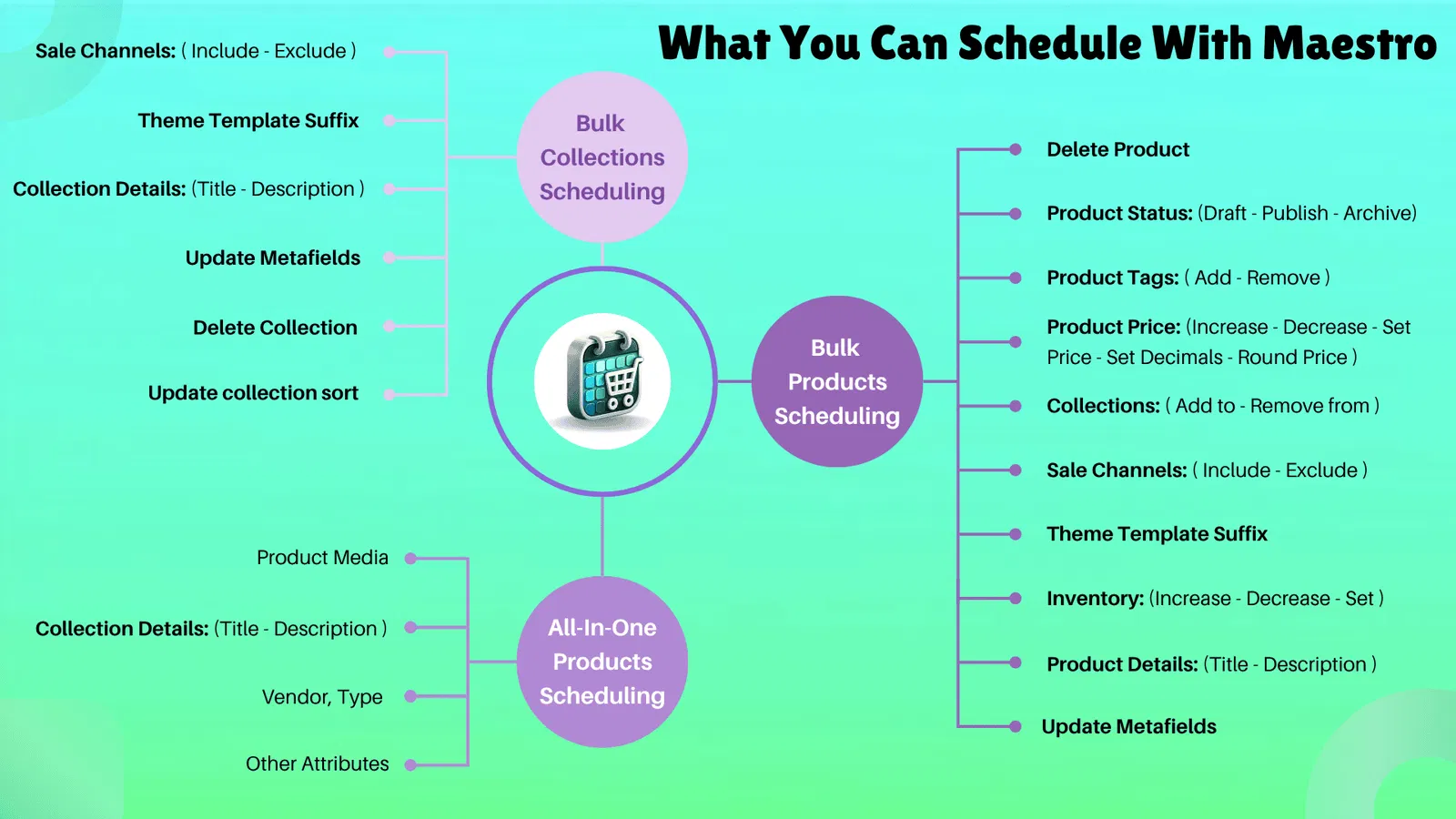
The Product Scheduler by Maestro is not just a basic scheduling tool. It is a comprehensive suite designed to automate the lifecycle of your products and collections. From the moment a product is created as a draft to the time it goes on sale or gets archived, Maestro handles the heavy lifting.
1. Mastering the Draft Helper for Seamless Launches
One of the most common headaches is preparing a product launch. You have the photos, the descriptions, and the inventory ready, but you do not want the product visible to the public until the exact second your campaign starts.
The "Draft Helper" feature allows you to prepare everything in advance. You can set the product to "Active" status at a specific date and time, ensuring that your shopify store setup remains clean and professional.
How to set up a scheduled launch:
- Navigate to the Maestro app within your Shopify admin.
- Select the products you wish to launch.
- Choose the "Product Status" action and set it to "Active."
- Specify the exact date and time for the change to occur.
- Save the schedule and let the app handle the rest.
By using this feature, you ensure that your site is always updated on time, which is a vital component of a successful conversion rate optimization strategy. Customers trust brands that are punctual and organized.
2. Automated Tag Management for Dynamic Stores
Tags are the invisible threads that hold your Shopify store together. They power your filters, your automated collections, and even some of your marketing integrations. However, managing tags manually is a nightmare, especially during seasonal transitions.
Imagine you are running a "Summer Essentials" sale. You need to add the tag "Summer2026" to five hundred products on June 1st and remove it on August 31st. Doing this manually is a recipe for disaster.
Benefits of automated tagging:
- Dynamic Collections: Automatically add or remove products from specific collections by scheduling tag changes.
- Improved Searchability: Ensure that seasonal products are easily findable during peak periods.
- Better Filtering: Keep your sidebar filters relevant by removing tags from items that are no longer part of a specific promotion.
With Maestro, you can schedule these tag additions and removals months in advance. Once the schedule is set, you can forget about it, knowing your store will stay organized and your customers will always find what they are looking for.
3. Price Automation and the Power of Rounding Rules
Pricing is a psychological game. If you are manually changing prices for a weekend sale, you are likely missing out on the nuance of rounding rules. A price of $19.99 often converts better than $20.00, but calculating these decimals across a large catalog is exhausting.
Maestro allows you to schedule price changes in bulk. More importantly, it features rounding rules that ensure your prices always look professional and consistent with your brand identity.
Steps to automate your pricing strategy:
- Select the products or collections that need a price adjustment.
- Choose the "Price" action and enter the percentage or fixed amount change.
- Apply a "Rounding Rule" (e.g., round to the nearest .99 or .95).
- Set the start and end time for the sale.
- Enable the "Revert" option to automatically return to original pricing once the sale ends.
This level of precision is exactly what high-volume stores need to maintain their edge. You can learn more about how we implement these strategies by visiting our growth strategies page.

4. Inventory Automation: Never Miss a Restock Opportunity
Nothing kills a conversion faster than an "Out of Stock" button. While you cannot always control your supply chain, you can control how your store reacts to inventory changes.
Maestro helps you manage the visibility of products based on their inventory levels. If a product is out of stock, you can automatically hide it or move it to the bottom of the collection. When the restock arrives, the app can automatically make it visible again and add a "Back in Stock" tag to trigger your marketing workflows.
How to automate restock visibility:
- Set Inventory Triggers: Create a schedule that checks inventory levels and changes product status accordingly.
- Automate "New Arrival" Badges: When inventory goes from zero to one hundred, have the app automatically add a "New" or "Restocked" tag for a set period.
- Sync with Marketing: Use these automated tags to feed into your email marketing platform, notifying customers that their favorite items are back.
5. Managing Collection Visibility and Sorting
Your homepage and collection pages are your digital storefront windows. If they look the same for six months, your returning customers will get bored. However, manually re-sorting collections every week is a task most merchants ignore because it is so time-consuming.
Maestro allows you to schedule changes to collection visibility and even the theme templates used for specific collections. This means you can have a "Holiday Theme" for your collection pages that automatically activates on December 1st and reverts to the "Standard Theme" on January 2nd.
Enhance your store layout with these steps:
- Navigate to the "Collection Management" section in the Maestro app.
- Choose to schedule the "Theme Template Suffix" to change the look of your collection.
- Set the "Sort Order" to "Newest" for the first week of a launch, then switch to "Best Selling" for long-term performance.
- Schedule the entire collection to be "Hidden" or "Visible" based on your promotional calendar.
This type of automation is a cornerstone of professional ecommerce maintenance services. It ensures your store always feels fresh and curated without requiring daily intervention.

Putting it All Together: A Hands-Off Success Story
Let us look at a practical example. Imagine a clothing brand launching a new Spring collection. Without automation, the owner spends the night before the launch manually updating five hundred products. They are tired, they miss a few tags, and the "Spring" collection page does not actually show up on the navigation menu until ten minutes after the email blast went out.
Now, imagine the same brand using the Product Scheduler by Maestro. Two weeks before the launch, the owner spends one hour setting up the following:
- Draft Helper: All products are scheduled to go "Active" at 9:00 AM on Monday.
- Tag Management: The "Spring2026" tag is scheduled to be added at 9:00 AM, automatically populating the "Spring Collection" page.
- Price Rounding: An introductory 10% discount is applied, with a rounding rule to keep all prices ending in .95.
- Collection Visibility: The "Spring" collection link is scheduled to appear in the navigation at exactly 9:00 AM.
On Monday morning, the owner is having coffee or focusing on their next big marketing campaign. The store updates itself perfectly. This is the power of a hands-off store.
Ready to Automate Your Success?
Automating your inventory is not just a luxury; it is a necessity for any merchant serious about scaling. By removing the burden of manual tasks, you reduce errors, save time, and provide a better experience for your customers. This directly impacts your bottom line and your sanity.
If you are looking for a partner to help you build or optimize your Shopify presence, our team at XCO Agency is ready to help. From shopify design services to complex shopify integrations, we specialize in making ecommerce work for you.
To start your journey toward a hands-off store, I highly recommend exploring the features of the Maestro Theme Scheduler. It is the tool we trust to handle the heavy lifting for our clients.
Taking the next step is simple:
- Evaluate your current workflow: Identify the manual tasks that take up the most time.
- Install Maestro: Start automating your product launches and price changes.
- Scale with confidence: Use the time you save to focus on growth and strategy.
If you have questions about how to integrate these automations into your specific business model, feel free to contact us or book a meeting with one of our experts. Let us turn your Shopify store into a well-oiled, automated machine.
Automating your store is a proactive step that pays dividends in both time and revenue. Do not wait for the next manual data entry error to make the switch. Start building your hands-off store today.