
As a Shopify Plus expert, I'm frequently asked by enterprise merchants: "Should we invest in a fully custom theme, or can we scale with a premium template?" It's a question that involves significant budget, strategic implications, and long-term maintenance considerations. In 2026, with Shopify's Online Store 2.0 architecture maturing and template quality improving dramatically, the answer has become more nuanced than ever.
The reality is that most merchants fall somewhere between "we need everything custom" and "a template will do forever." The key is understanding when template limitations start costing you real revenue, and when custom development delivers measurable ROI. Let me walk you through a practical decision framework based on what I've seen working with growing brands.
The "Conversion Ceiling": When Template Limits Start Hurting Revenue
Every premium Shopify theme has an invisible ceiling. It's not about aesthetics anymore, most premium templates look sophisticated and professional. The ceiling appears when your conversion rate optimization (CRO) strategy outgrows what the theme's settings panel can deliver.
Here are the signs you're hitting that ceiling:
Revenue metrics plateau despite traffic growth - You're driving more qualified visitors to your store, but your average order value (AOV) and conversion rate (CVR) have stagnated. You've A/B tested every variant of your product pages that the theme allows, but you're out of optimization levers to pull.
Your checkout flow needs aren't met - You require custom pre-purchase flows, subscription logic, or B2B pricing displays that templates simply can't accommodate without breaking their update compatibility.
Product complexity exceeds standard layouts - If you're selling configurable products, bundles with dynamic pricing, or items requiring sophisticated variant displays, template limitations become painfully obvious.
You're hacking workarounds - Your team is constantly finding creative (and fragile) solutions using metafields, custom liquid snippets, and third-party apps to compensate for theme restrictions. Each workaround adds technical debt and potential breaking points.

The conversion ceiling isn't about vanity, it's about hitting real business constraints. When incremental improvements to your AOV or CVR are worth thousands in monthly revenue, template limitations become expensive barriers.
Custom Logic: The Product Maestro Advantage
Here's where bespoke theme development truly shines: advanced product logic that adapts to your business rules, not the other way around.
At XCO Agency, I often integrate our custom theme builds with Product Maestro, our automation solution for sophisticated product scheduling and visibility logic. This combination unlocks capabilities that templates simply cannot offer:
Dynamic product displays based on complex rules - Show different product variants, pricing tiers, or messaging based on customer tags, purchase history, geographic location, or time-based campaigns. This goes far beyond basic "hide/show" functionality.
Campaign-specific experiences - Launch flash sales, seasonal promotions, or market-specific offers without creating duplicate product pages or manually updating your theme. Everything runs on scheduled automation that your marketing team can control.
Personalization at scale - Serve different content blocks, hero sections, or product recommendations based on customer segments. This level of personalization requires custom theme architecture that can receive and respond to dynamic data.
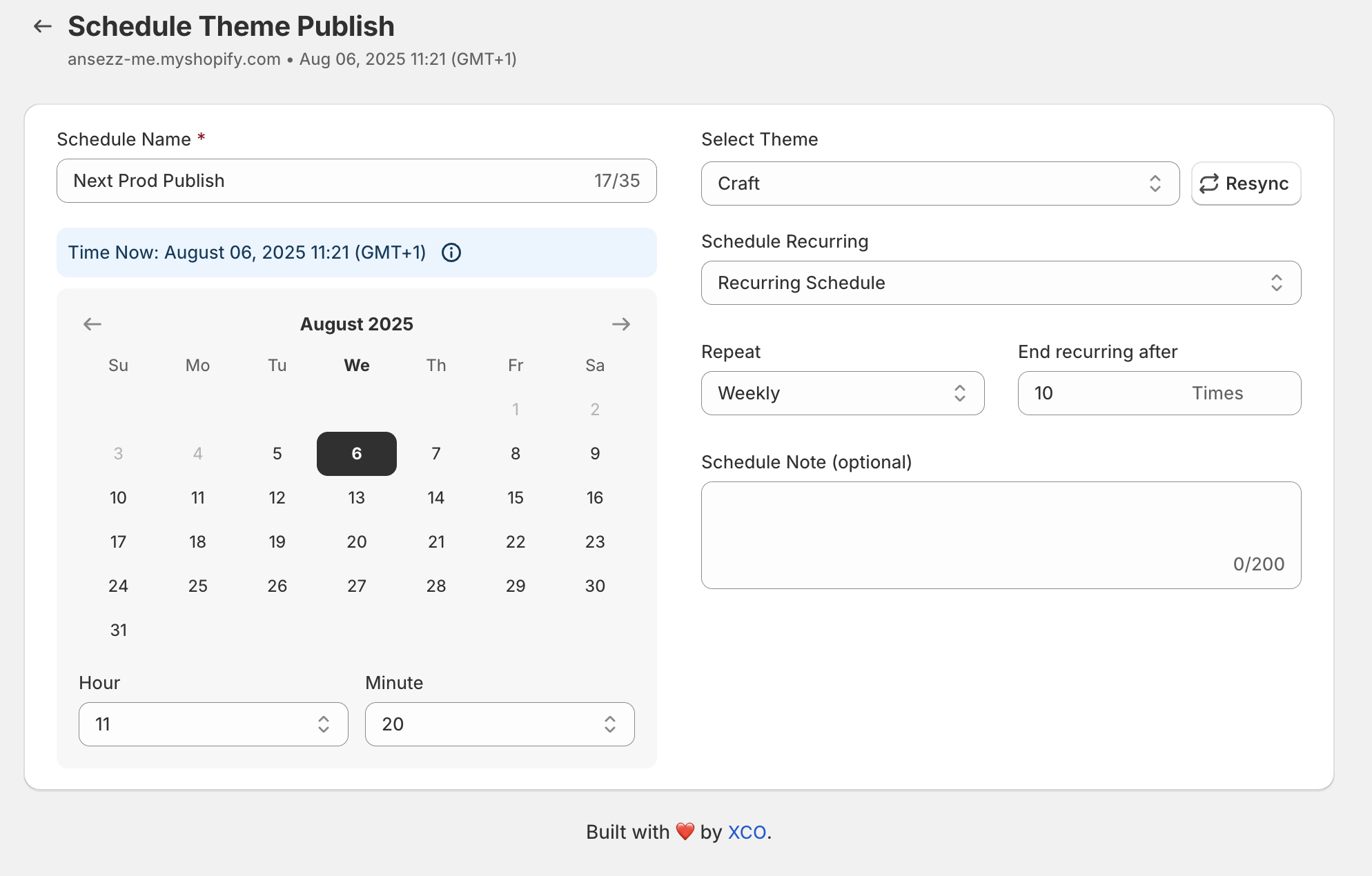
When we build custom themes with Maestro integration in mind, merchants gain the ability to execute sophisticated merchandising strategies without developer intervention for every campaign. Your marketing team gets autonomy while maintaining brand consistency and performance standards.
The Maintenance Reality: What Nobody Tells You
Let's address the elephant in the room: custom themes require ongoing maintenance. This isn't a scare tactic, it's reality, and you need to budget for it.
Template advantages:
- Automatic updates for browser compatibility, security patches, and Shopify platform changes
- Themes in the Shopify theme store undergo rigorous quality testing
- Built-in support channels and documentation
- Community of users finding and reporting issues
Custom theme responsibilities:
- Your development team (in-house or agency) owns all updates and bug fixes
- Shopify platform updates may require theme adjustments
- No automatic patches, everything requires intentional maintenance
- Testing burden falls entirely on you

However, here's the nuance most agencies won't tell you: well-architected custom themes built on Online Store 2.0 standards are significantly easier to maintain than legacy custom themes. When we follow Shopify's best practices and modular architecture principles, maintenance overhead decreases dramatically.
The real question isn't "custom vs. template maintenance", it's "do we have the resources and commitment to own our theme's evolution?" If the answer is yes, and the business case justifies it, custom development delivers control and flexibility that templates cannot match.
The XCO Hybrid Approach: Premium Foundation + Custom Engineering
After building dozens of high-performance Shopify Plus stores, I rarely recommend pure custom builds from scratch. The investment rarely justifies itself unless you're a multi-million dollar brand with truly unique requirements.
Instead, we advocate for what I call the "Hybrid Build" approach:
Start with a premium, performant foundation - Select a well-architected OS 2.0 theme (often Dawn-based or another performance-optimized framework) that handles the core commerce functionality beautifully.
Custom-engineer strategic feature blocks - Identify the 3-5 areas where your business genuinely needs differentiation: maybe it's your product configurator, your bundle builder, your subscription flow, or your B2B portal. Build custom sections and blocks for these specific needs.
Integrate automation infrastructure - Layer in tools like Maestro Theme Scheduler to enable sophisticated campaign management without constant developer involvement.
Maintain template update compatibility - Structure custom code as discrete sections and blocks that don't interfere with core theme updates, giving you the best of both worlds.

This approach typically delivers 80% of custom theme benefits at 40% of the cost and maintenance burden. You get the flexibility where it matters most while maintaining the stability and update path that templates provide.
Your Decision Framework: Custom vs. Template in 2026
Use this framework to evaluate your specific situation:
Choose a premium template if:
- Your annual revenue is under $2-3M and growing
- You need to launch quickly (within 4-8 weeks)
- Your product catalog and customer journey fit standard e-commerce patterns
- You don't have dedicated development resources for ongoing maintenance
- Your conversion optimization is still in early stages
Invest in hybrid custom development if:
- You're generating $3M+ annually with clear growth trajectory
- You've identified specific template limitations costing you conversions
- You need advanced product logic or merchandising automation
- You have (or can hire) development resources for maintenance
- Your brand positioning demands distinctive user experiences
Consider a full custom build only if:
- You're an established enterprise brand ($10M+ revenue)
- Your business model has truly unique requirements that no template can accommodate
- You have an in-house or dedicated agency development team
- The ROI calculation clearly justifies the 3-4x investment over hybrid approaches
For most Shopify Plus merchants reading this, the hybrid approach offers the sweet spot: strategic customization where it drives revenue, template stability everywhere else, and automation tools that give your team control without constant development tickets.
Moving Forward
The template vs. custom debate isn't binary anymore. With Online Store 2.0's modular architecture and powerful automation tools like Product Maestro, you can build sophisticated, high-converting stores without choosing all-or-nothing approaches.
At XCO Agency, we specialize in finding that optimization point for each merchant: where investment in customization delivers measurable returns without unnecessary complexity. Whether you need a performance audit of your current template, strategic custom feature development, or a full hybrid build, we approach every project with the same question: what will actually move your revenue metrics?
If you're evaluating your theme options for 2026 and beyond, let's talk through your specific situation. Sometimes a few strategic customizations make all the difference. Other times, you're better off optimizing what you have. The key is making data-driven decisions based on your business reality, not industry hype.
Ready to explore your options? Reach out to discuss your custom theme strategy and let's build something that drives real results for your store.