
As a Shopify expert, I often see merchants treating a product launch like a high-stakes military operation. There are usually three pots of coffee involved, at least one person awake at 2 AM to hit a "Publish" button, and a lingering sense of dread that someone forgot to update the collection tags. It is a chaotic way to run a business, and frankly, your sleep schedule deserves better.
The reality of modern ecommerce is that manual labor is the enemy of scale. If you are still manually moving products from draft to active or clicking through dozens of pages to change prices for a flash sale, you are not just wasting time. You are increasing the margin for human error that can tank your conversion rate optimization efforts.
At XCO Agency, we believe that your Shopify store setup should work for you, not the other way around. Five minutes might sound like a late-night infomercial promise, but when you leverage the right automation tools, it is the actual amount of time it takes to queue up an entire season of launches.
Why Manual Launches Are Killing Your Productivity
Before we dive into the "how," we need to address the "why." Most merchants seek out ecommerce maintenance services because they are overwhelmed by the minutiae of daily operations. A manual launch process is a productivity killer for several reasons:
- The 2 AM Alarm Clock: Global audiences do not wait for your local time zone. If your peak traffic hits at midnight, you are either losing sales or losing sleep.
- The "Broken Link" Syndrome: Manually adding products to collections often leads to mistakes where a product is live but invisible to the customer.
- Tagging Nightmares: Forgetting to add a "New Arrival" or "Summer Sale" tag means your smart collections will not populate correctly, hurting your site navigation.
- Pricing Inconsistency: Changing prices one by one during a launch is a recipe for disaster, especially if you have hundreds of SKUs.
By automating these tasks, you transition from being a digital stock clerk to a strategic growth strategist.
The Secret Weapon: Maestro Product Scheduler
The core of a 5-minute automated launch lies in the Maestro app. We built this tool at XCO Agency specifically because we saw our clients struggling with the limitations of native Shopify scheduling. While Shopify allows for basic publishing, it lacks the "smart" features required for a truly hands-off store.

Step 1: Using the Draft Helper for Seamless Transitions
The first step in your 5-minute setup is preparing your products in draft mode. In a traditional setup, you would have to manually switch these to "Active" at the moment of launch. With Maestro’s Draft Helper, you can pre-configure exactly when those drafts should go live.
- Select your draft products: Group the items you want to launch.
- Set the trigger: Choose the exact date and second you want them to appear.
- Automate the status change: The app will handle the transition from draft to active without you needing to be logged into the admin panel.
This ensures that your Shopify store setup remains clean and organized, with no "leakage" of products appearing on the site before they are ready.
Step 2: Automated Tag Management for Seasonal Sales
Tags are the lifeblood of Shopify organization. They control everything from filtering to automated collections. During a launch, you often need to add specific tags (like "Limited Edition" or "Winter 2026") and remove them once the launch phase is over.
Doing this manually for 50 products takes forever. With automated tag management, you can:
- Schedule tag additions: Add the "New Arrival" tag at the moment of launch.
- Schedule tag removals: Set an expiration date for that tag so the product automatically moves out of the "New" section after two weeks.
- Maintain SEO consistency: Proper tagging helps with internal linking and search visibility, which is vital for long-term growth.
https://cdn.marblism.com/sSiQKJOr9tT.webp
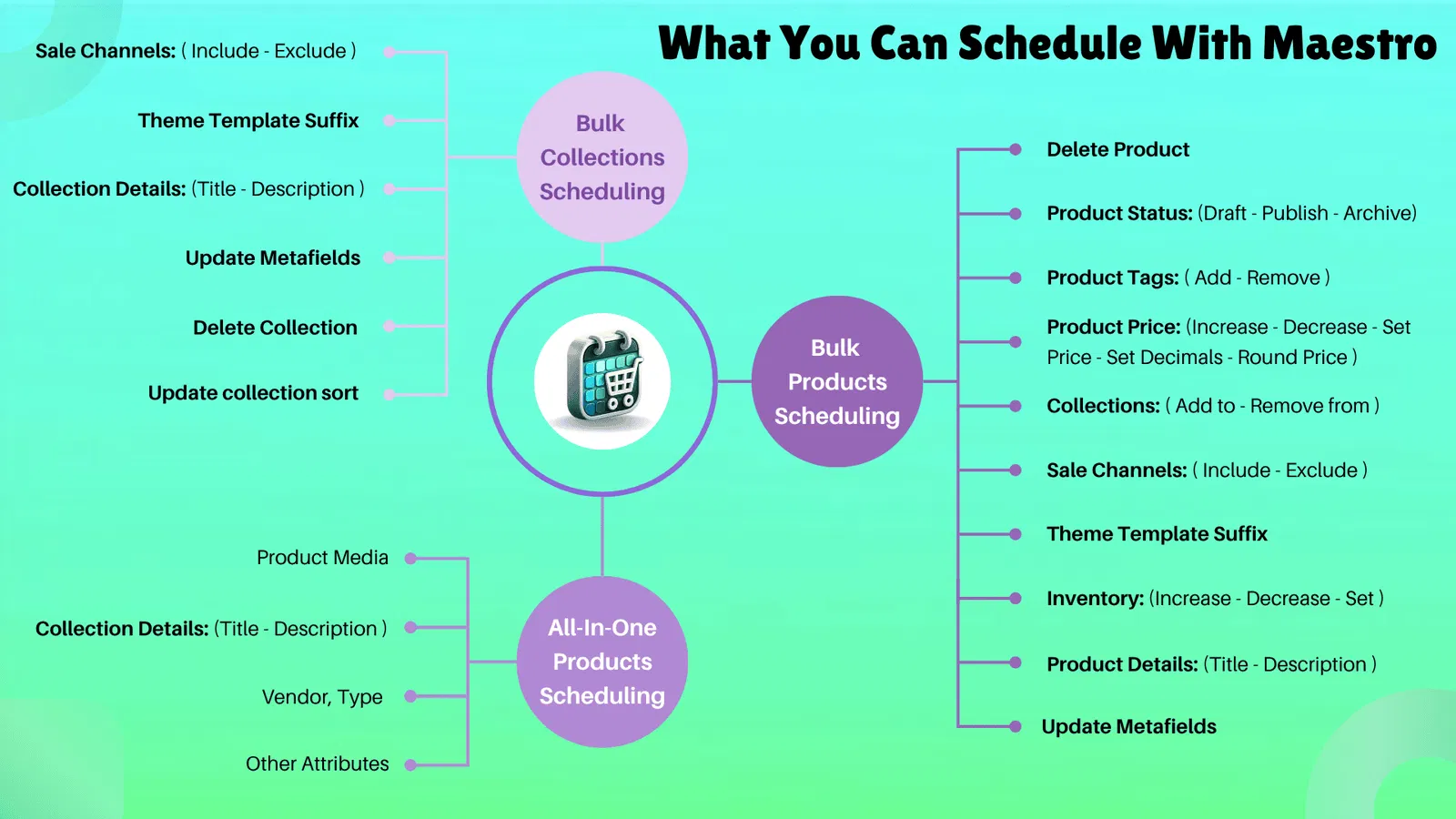
Step 3: Scheduling Price Changes and Rounding Rules
Nothing screams "unprofessional" like a sale price that ends in an awkward number like $42.37 because of a percentage-based discount. Professional merchants use rounding rules to keep their storefront looking sharp.
When you use Maestro to schedule your launch prices, you can apply global rules:
- Define the discount: Set a launch-day discount for specific collections.
- Apply rounding rules: Ensure all prices end in .99 or .00 automatically.
- Set the revert date: Schedule when the prices should return to their original MSRP.
This level of precision is essential for conversion rate optimization. Customers trust clean, consistent pricing, and automation ensures you never accidentally leave a "sale" price active for months after the event ends.
Step 4: Inventory Automation and Restock Logic
A product launch is only successful if you actually have the inventory to back it up. However, managing restocks and visibility based on stock levels is a constant battle.
As part of your 5-minute setup, you should configure inventory logic. This means telling your store to:
- Hide products when they hit zero: Prevent customer frustration by automatically removing out-of-stock items from featured collections.
- Show products upon restock: As soon as your warehouse updates the quantities, the product becomes visible again without manual intervention.
- Automate "Back in Stock" tags: Use tags to trigger notifications or move products to a "Restocked" collection automatically.
Step 5: Managing Collection Visibility and Sorting
The final piece of the automated launch puzzle is the collection itself. It is one thing for a product to be "Active," but it is another for it to be prominently displayed on your homepage or in a specific category.
With the Maestro app, you can schedule the visibility of entire collections or even specific sections and blocks within your theme.
- Schedule the Collection: Make the "Spring Collection" page live at 8:00 AM on Monday.
- Set the Sorting: Force new arrivals to the top of the collection page for the first 48 hours to maximize exposure.
- Automate Theme Changes: If you are using Maestro Theme Scheduler, you can even schedule a change to your homepage banner to match the launch.
https://cdn.marblism.com/P0R0NAdYGsz.webp

The Compound Effect of Hands-Off Management
When you combine these five steps, you are doing more than just "scheduling a post." You are creating a self-sustaining ecosystem. The time you save on these repetitive tasks can be reinvested into high-level strategy, such as influencer outreach, ad creative, or Shopify B2B wholesale channel expansion.
As a Shopify expert, I have seen stores double their output simply by removing the bottleneck of manual site updates. When the fear of "breaking the site" is removed by reliable automation, your team can move faster and experiment more frequently.
Why XCO Agency Recommends a Proactive Approach
Many merchants wait until they are drowning in manual tasks before they look for ecommerce maintenance services. We recommend being proactive. Whether you are migrating from another platform or starting fresh, building automation into your foundation is the smartest move you can make.
If you are looking for a way to streamline your operations, start with these simple steps:
- Audit your current launch process: Count how many manual clicks it takes to go live.
- Identify the "human error" points: Where do things usually go wrong? (e.g., tags, prices, or inventory).
- Implement a tool like Maestro: Let the software handle the timing so you can handle the vision.
https://cdn.marblism.com/U31zNHRR3xM.png

Conclusion: Reclaiming Your Time
A fully automated product launch is not a myth; it is a competitive advantage. By using tools like the Maestro Product Scheduler, you can handle the draft-to-active transition, tag management, pricing rules, and collection visibility in one fell swoop. This level of automation reduces the stress on your team and ensures a flawless experience for your customers.
Running a Shopify store should be about growth and creativity, not about staying up until dawn to toggle a switch. By automating the heavy lifting, you allow yourself the freedom to focus on what actually moves the needle for your brand.
Are you ready to stop being a slave to your Shopify admin? At XCO Agency, we specialize in helping merchants optimize their stores for maximum efficiency and scale. Whether you need help with Shopify speed optimization or a complete migration to Shopify, we are here to help.
Take the first step toward a hands-off store today. Book a meeting with our experts or explore our suite of Shopify apps to see how we can transform your workflow from manual to magnificent.