
As a Shopify expert, I often work with merchants who are scaling faster than their manual workflows can handle. They start with ten products and a dream, but suddenly they have five hundred SKUs, a seasonal sale every two weeks, and a mounting pile of ecommerce maintenance services that eat into their sleep. The "dream" starts to look a lot like a nightmare of endless CSV imports and midnight product launches.
Most store owners are seeking a way to reclaim their time without sacrificing the quality of their storefront. They want a "set it and forget it" system that manages product visibility, pricing, and inventory logic automatically. If you have ever stayed up until 11:59 PM just to hit "Publish" on a new collection or to change a price for a flash sale, this guide is for you.
Automating your entire Shopify product catalog does not require a degree in computer science. With the right tools, specifically the Product Scheduler by Maestro, you can set up a month of store updates in less time than it takes to brew a fresh pot of coffee.
Why Catalog Automation is a Growth Lever
Before I dive into the "how," let's address the "why." Automation is not just about laziness. It is about precision and scalability. When you automate your shopify store setup, you achieve three critical goals:
- Human Error Elimination: Manual updates often lead to broken links, incorrect pricing, or products appearing in the wrong collections.
- Conversion Rate Optimization: By ensuring your store always looks fresh and products are never "Out of Stock" when they should be "Hidden," you maintain a professional edge that keeps customers buying.
- Strategic Flexibility: Instead of doing the work, you spend your time planning growth strategies that actually move the needle.

Step 1: Mastering the Draft Helper for Scheduled Launches
The biggest bottleneck in any product launch is the transition from "Draft" to "Active." Most merchants prepare their listings days in advance but have to manually toggle them live.
As a Shopify consultant, I recommend using the Draft Helper feature within the Maestro app. This allows you to prepare your entire seasonal drop in advance. You can set the exact second a product should go live across all your sales channels.
- Prepare in Bulk: Upload your products as drafts throughout the week.
- Set the Trigger: Use Maestro to schedule the status change from Draft to Active.
- Coordinate with Themes: If you are launching a major collection, ensure your Shopify design services team has the banners ready to go live at the same time.
By scheduling these launches, you ensure that your marketing emails and social posts align perfectly with your store's reality. There is nothing worse for conversion rate optimization than a "Link in Bio" that leads to a 404 page because you forgot to hit publish.
Step 2: Automated Tag Management for Seasonal Sales
Tags are the invisible engine of your Shopify store. They control everything from smart collections to filtering sidebars. However, managing them manually during a sale is a recipe for disaster.
I often see stores running a "Black Friday" collection that still has products in it three weeks after the sale ended. This looks sloppy and hurts your brand authority. With automated tag management, you can schedule the addition and removal of tags based on specific dates.
- Dynamic Collections: Set a rule to add the tag "Winter-Sale" to specific items on December 1st and remove it on January 1st.
- Automated Filtering: Ensure your "New Arrivals" tag actually reflects products that arrived this month, not six months ago.
- SEO Cleanliness: Keeping your tags organized helps search engines understand your store structure better.
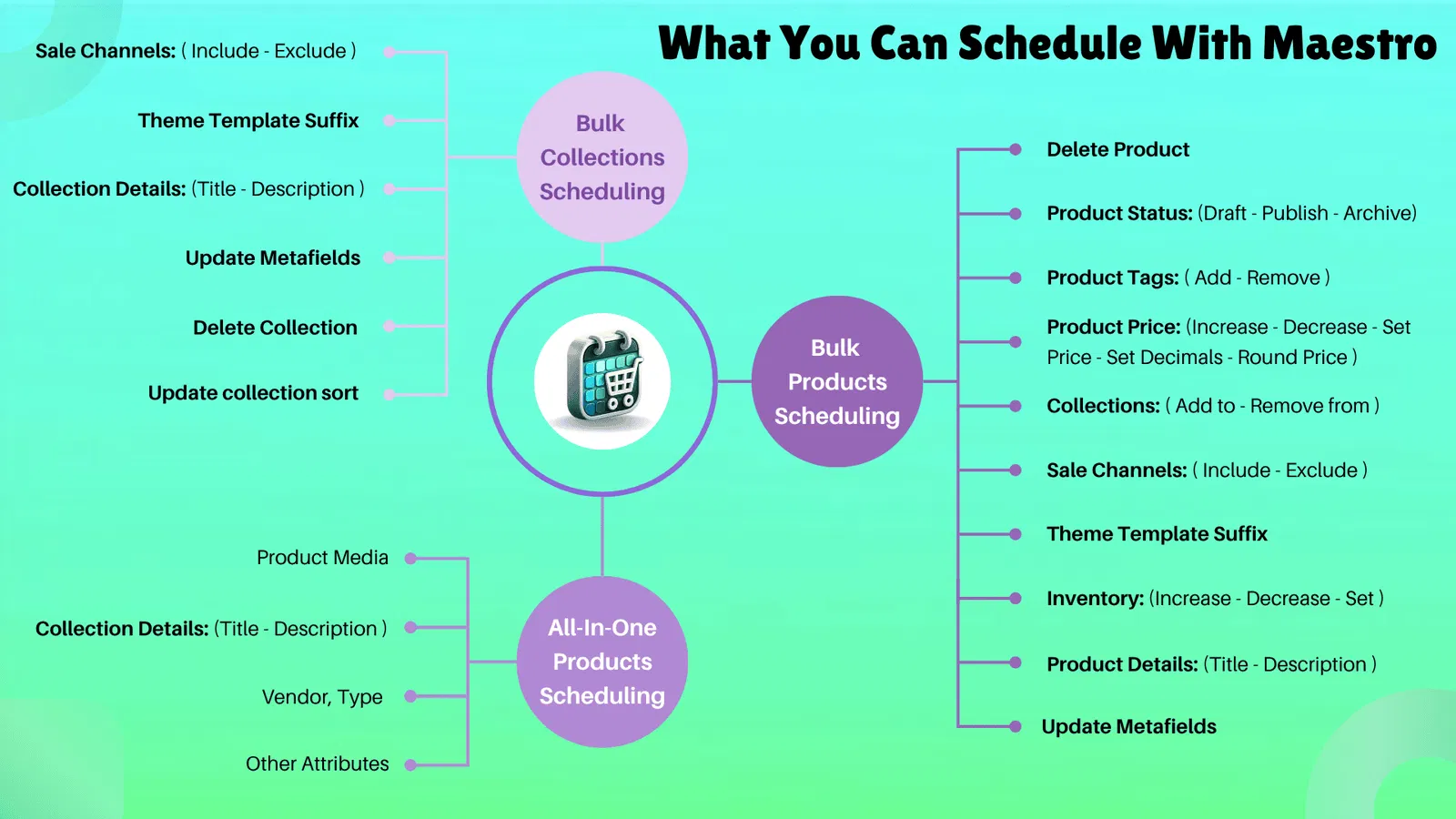
Step 3: Scheduling Price Changes and Rounding Rules
Pricing is a psychological game. A product priced at $19.99 often performs better than one at $20.00. When you are running a sitewide 20% off sale, your math might result in messy decimals like $16.32. This looks unprofessional.
The Product Scheduler by Maestro allows you to schedule price changes across your entire catalog or specific collections. More importantly, it includes rounding rules.
- Bulk Adjustments: Increase or decrease prices by a percentage or fixed amount.
- Professional Finish: Apply rounding rules so every price ends in .99 or .00 automatically.
- Timed Reversals: Schedule the "Compare at Price" to disappear exactly when your promotion ends.
This level of control is vital for high-volume stores that need to maintain consistent margins while staying competitive. If you need help setting up these complex logic flows, our team at XCO Agency can assist with Shopify integrations to ensure your tech stack is talking to each other.
Step 4: Inventory Automation for Restocks
Managing expectations is the key to customer retention. If a product is out of stock, it should either be hidden or moved to the bottom of the collection. Manual sorting is impossible for large catalogs.
You can automate this process by setting inventory triggers. When a product hits zero, Maestro can automatically change its visibility or move it to a "Hidden" status. Conversely, when your new shipment arrives, the app detects the inventory increase and sets the product back to "Active."
- Restock Alerts: Automatically tag products as "Back in Stock" to trigger automated email flows.
- Catalog Cleanliness: Prevent customers from scrolling through pages of "Sold Out" items, which significantly boosts your conversion rate optimization.
- Hands-Off Restocks: Focus on your supply chain while the store manages the front-end display.

Step 5: Managing Collection Visibility and Sorting
Your homepage and collection pages are your digital real estate. You want the most profitable and relevant items at the top. As seasons change, your priorities change too.
Instead of manually dragging and dropping products in the Shopify admin, you can schedule collection sorting rules.
- Timed Visibility: Schedule an entire collection to become visible only during a specific holiday weekend.
- Smart Sorting: Move high-inventory items to the top automatically to clear warehouse space.
- Theme Integration: Use Maestro to switch your theme templates based on the schedule, ensuring your migration to Shopify or recent redesign is fully utilized.

Implementing the 5-Minute Automation Workflow
Here are simple steps to get your automation running today. After completing these, you will have a store that practically runs itself.
- Install the Maestro App: Navigate to the Shopify App Store and search for Product Scheduler by Maestro.
- Select Your Products: Use the bulk selector to choose the products or collections you want to automate.
- Define the Action: Choose whether you are changing price, tags, status, or visibility.
- Set the Timeline: Select the start and end date for your automation.
- Review and Launch: Double-check your settings and hit schedule.
Once your automation is set, the app handles the heavy lifting. You can view all your upcoming changes in a centralized calendar view, giving you a bird's eye perspective of your store's future. This is a vital step for any merchant looking to move from "store owner" to "CEO."
The Bottom Line: Work Smarter, Not Harder
As a Shopify expert, I have seen the difference between merchants who work in their business and those who work on it. Automation is the bridge between those two states. By utilizing the Product Scheduler by Maestro, you eliminate the tedious manual tasks that lead to burnout and human error.
Whether you are preparing for a massive Black Friday launch or just want your "New Arrivals" to actually be new, automation provides the consistency your customers expect. It allows you to offer a polished, professional shopping experience that rivals major retailers.
If you are feeling overwhelmed by your current shopify store setup or need a professional touch to audit your workflows, we are here to help. At XCO Agency, we specialize in high-growth ecommerce maintenance services that allow you to focus on the big picture.
Ready to take your store to the next level? Book a meeting with our experts today, or check out our FAQs to learn more about how we can optimize your Shopify experience. Don't let your catalog manage you; start managing your catalog with the power of automation.