
As a Shopify expert, I often work with merchants who are scaling so fast they are practically tripping over their own growth. It starts with a few products, then dozens, then hundreds. Suddenly, your Wednesday afternoon is not spent on growth strategies or conversion rate optimization, it is spent in a spreadsheet purgatory, manually toggling product statuses and praying you did not set a price to one dollar instead of one hundred.
I have seen the internal chaos that comes with manual catalog management. It is more than just a time suck. It is a silent killer of your bottom line. When your shopify store setup relies on human fingers clicking buttons at exactly 12:00 AM, you are one missed alarm away from a failed product launch.
At XCO Agency, we focus on helping brands transition from manual struggle to automated success. One of the most powerful tools in our arsenal for this is the Product Scheduler by Maestro. Here is why your manual process is failing you and how automation can give you your life back.
1. The Midnight Launch Martyrdom
We have all been there. You have a big drop scheduled for Monday. Instead of enjoying your Sunday evening, you are sitting at your computer, waiting for the clock to strike midnight so you can manually change products from Draft to Active.
This is the most common mistake in ecommerce maintenance services. Relying on manual timing is a recipe for burnout. If you are five minutes late, your early access customers are frustrated. If you are five minutes early, you break the hype.
The Product Scheduler fixes this with its Draft Helper feature. You can set the exact second you want a product to go live. You set it on Friday, you go to the beach on Sunday, and the app handles the heavy lifting. Shopify will guide you through the initial setup, but Maestro ensures the execution is flawless while you sleep.
2. The Ghost Product Nightmare
Have you ever visited a site, saw a sale banner, clicked it, and found a bunch of products that were definitely not on sale? Or worse, you see a Sale tag on a product that is actually full price?
Manual tag management is a disaster waiting to happen. Merchants often forget to remove seasonal tags like Summer Sale or Black Friday. These ghost tags confuse customers and hurt your conversion rate optimization by creating a lack of trust.
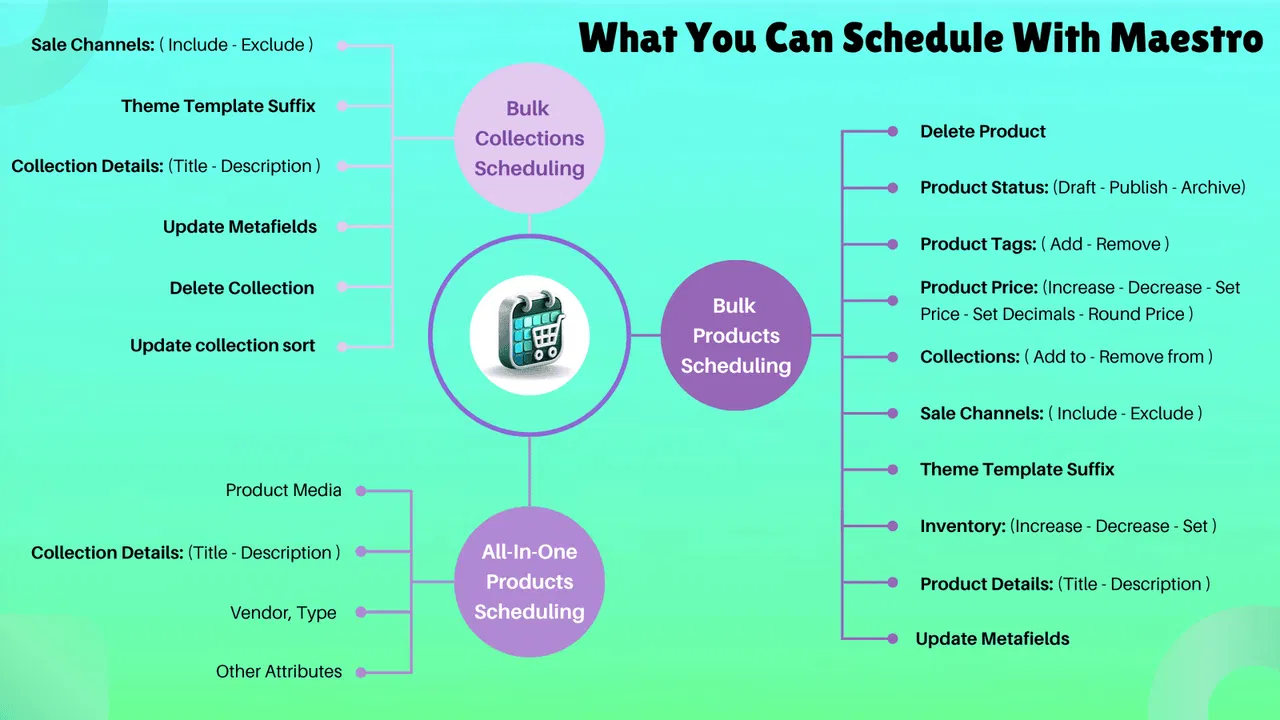
Using an automated system allows you to schedule tag additions and removals. When the sale ends at midnight, the app automatically strips the Sale tag and adds a New Arrival tag if necessary. This ensures your collection filters actually work and your customers never see outdated information.
3. The Pricing Oopsie and Rounding Rituals
Pricing errors are expensive. I once saw a merchant lose thousands in an hour because a manual update missed a decimal point. Beyond the errors, there is the tedious task of rounding. Most high end brands want their prices to end in .00 or .99 for a clean look.
Doing this manually across 500 SKUs is a form of torture. When you use a dedicated product scheduler, you can implement price changes and rounding rules simultaneously.
- Navigate to the Maestro app dashboard.
- Select the products or collections you want to update.
- Set a percentage increase or decrease.
- Apply a rounding rule (e.g., always end in .95).
- Schedule the start and end date for these prices.
This level of precision is impossible with manual entry. It ensures your margins stay healthy and your store looks professional without you having to touch a single cell in Excel.

4. Inventory Synchronization Failures
A major mistake merchants make is failing to sync their marketing with their actual stock levels. You might have a restock coming in, but if you do not update the product status the moment that inventory hits the warehouse, you are losing sales.
Manual restock updates are slow. By the time you get the email from the warehouse and log into Shopify, hours have passed. Automation allows you to schedule inventory updates in advance. If you know a shipment is arriving Tuesday, you can pre-schedule that inventory increase and even trigger a back in stock email sequence automatically. This keeps your ecommerce maintenance services proactive rather than reactive.
5. The Messy Collection Syndrome
First impressions matter. If a customer lands on your New Arrivals collection and the first three items are out of stock or from last season, they are leaving. Managing collection visibility and sorting manually is a full time job.
I often see stores where the best sellers are buried on page four because someone forgot to update the manual sort order after a holiday weekend. Maestro allows you to manage collection visibility and sorting on a schedule. You can set specific blocks or sections to show or hide based on the time of day or specific dates.
For example, you can show a limited edition collection banner only during the hours of a flash sale. Once the sale is over, the section disappears, and your standard collection view returns. This maintains a high conversion rate optimization by always showing the most relevant content to your visitors.

6. Scattered Data and Human Error
Data decays at an alarming rate. When product information is spread across different team members or manual lists, mistakes multiply. One person thinks the sale starts at 9:00 AM, another thinks it is 10:00 AM.
Automation centralizes your schedule. Everyone can see exactly when products are launching, when prices are changing, and when tags are being updated. This single source of truth reduces the 25 percent increase in development cycles typically caused by scattered data.
If you are looking to scale, you need to remove the human element from repetitive tasks. Our Shopify speed optimization services often uncover that manual apps and heavy scripts used to "band-aid" these issues actually slow down the site. A clean, scheduled approach via a dedicated app like Maestro is much more efficient.
7. The Scaling Ceiling
The biggest mistake is thinking you can keep doing this manually forever. You might handle it with 50 products. You will struggle with 500. You will fail with 5,000.
Manual updates create a ceiling on how fast you can grow. If every new product launch requires five hours of manual labor, you will eventually stop launching products because it is too much work. Automation removes this ceiling. It allows you to plan an entire quarter of launches in a single afternoon.
At XCO Agency, we believe your time is better spent on Shopify design services or high level marketing than on clicking Publish over and over again.
Why Product Scheduler by Maestro is the Solution
As a Shopify expert, I recommend the Maestro app because it addresses these seven mistakes directly. It is designed for merchants who want a hands off store. Here is a summary of how it transforms your workflow:
- Draft Helper: Automate your launches so you can stay offline during peak times.
- Tag Management: Automatically clean up your site after sales to keep filters accurate.
- Price Rounding: Ensure professional pricing across your entire catalog with one click.
- Section Visibility: Show and hide specific parts of your store to match your marketing campaigns.
- Bulk Scheduling: Update thousands of attributes simultaneously without the risk of typos.

Taking the Proactive Step
Transitioning from manual updates to an automated catalog is a vital step for any growing Shopify Plus merchant. It reduces human error, saves dozens of hours every month, and ensures your customer experience is never compromised by a missed update or a typo.
If you are tired of the spreadsheet shuffle and want to see how automation can power up your store, we are here to help. Whether you need a full shopify store setup or just want to optimize your current workflow, the right tools make all the difference.
Stop being a martyr to your catalog. Let the technology do the boring work so you can get back to building your brand.
If you want to discuss how we can automate your store operations or help with your next big migration, feel free to book a meeting with our team. We have seen it all, and we know exactly how to fix the bottlenecks holding you back. For more information on our specific tools, visit the Maestro Theme Scheduler page to see the full list of capabilities.